
Powell holds the cards

Macro

The week revealed a two-speed US economy, showing unexpected resilience on some fronts despite a restrictive monetary environment. The labor market refuses to bend, with historically low weekly jobless claims (213,000) and new job openings (JOLTS) rebounding sharply to 6.946 million. The real estate sector also provided a surprise: existing home sales rebounded strongly to 4.09 million and housing starts exploded to 1.487 million, proving that buyers are adapting to high rates.
However, the inflation front remains extremely problematic for the Federal Reserve. While the CPI aligned with expectations, the Core PCE index proved particularly sticky, rising to 3.1% year-on-year. This persistence is explained by the strength of the American consumer who, despite declining morale (Michigan index falling to 55.5 but in line with expectations), refuses to reduce their lifestyle, with household spending increasing by a further 0.4%.
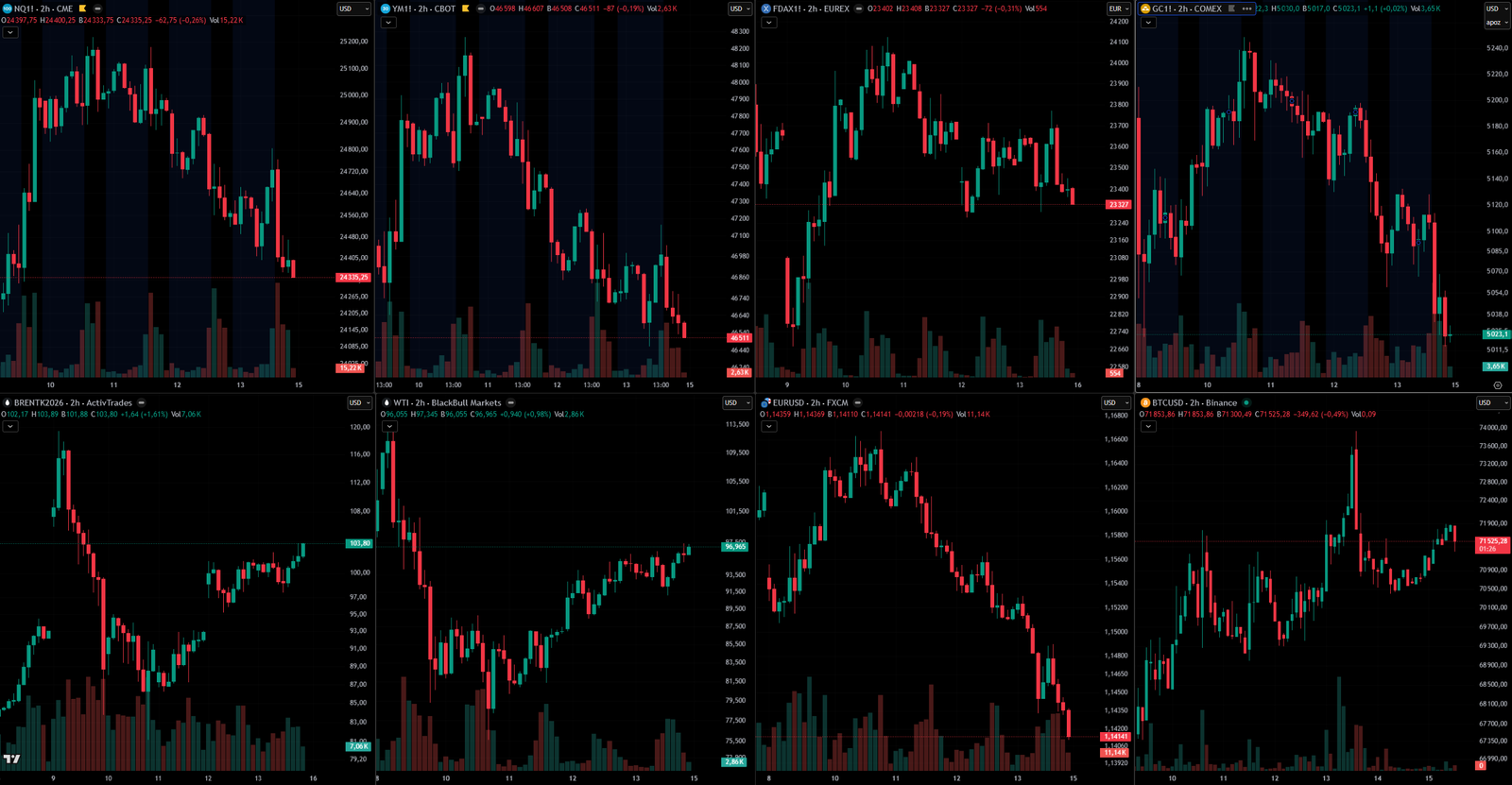
The situation darkened abruptly with the sharp downward revision of fourth-quarter GDP, which fell to a meager 0.7% (compared to the 1.4% expected). This collapsing growth, coupled with clinging inflation and surging oil prices (Brent crude exceeding $100 due to the war in Iran and the blockade of the Strait of Hormuz), materializes the dreaded picture of stagflation.
Trapped between a sharply slowing economy and stubborn inflation, the Federal Reserve’s hands are tied. Although such weak GDP would justify a rate cut, consumer resilience and Core PCE at 3.1% prevent it. Consequently, markets and analysts are now pushing back their expectations for the first rate cut to September.
For this Wednesday’s meeting, a maintenance of rates in the 3.5% to 3.75% range is widely anticipated, which led to a brutal week of stock market declines and strong risk aversion.
Summary
- Growth Shock and Stagflation: Violent downward revision of GDP in an environment where inflation remains stubborn.
- Fed Dilemma Pushing Back Cuts: Resilience in employment and consumer spending forces the Fed into a status quo, with rate cut expectations pushed back to September.
Upcoming Macro:
Wednesday, March 18, 2026
- 1:30 PM: Producer Price Index (Monthly) (Feb.)
- 3:30 PM: Crude Oil Inventories
- 7:00 PM: Fed Interest Rate Decision
- 7:30 PM: FOMC Press Conference
Thursday, March 19, 2026
- 1:30 PM: Philadelphia Fed Manufacturing Index (Mar)
- 1:30 PM: Weekly Jobless Claims
- 3:00 PM: New Home Sales (Jan.)
Saturday, March 21, 2026
- 3:30 PM: Speech by Fed Chair Powell
News

The week was dominated by the spectacular escalation of the conflict with Iran and its global repercussions on the energy market, pushing the US administration to increase emergency measures.
War in Iran and Global Crisis in the Strait of Hormuz:
Maritime traffic in the Strait of Hormuz has collapsed by 97%, notably blocking half of the LNG carriers in the Gulf. Military escalation is intensifying: the United States bombed targets on the Iranian island of Kharg (a nerve center for oil exports), and Iran retaliated by attacking the port of Fujairah in the United Arab Emirates, while threatening the US West Coast with drone attacks.
In response to this situation, Donald Trump called on the international community (China, France, UK, etc.) to send warships to secure the strait. In parallel, the United States is deploying an additional 2,500 Marines to the Middle East. Washington has also been approached by Kurdish opposition forces, who propose launching a vast ground offensive in Iran in exchange for US air support to topple the regime, although Donald Trump has blown hot and cold regarding his support for such an operation.
Emergency Measures for Oil Above $100
To counter the surge in crude prices before the midterm elections, the Trump administration has deployed an arsenal of exceptional measures. The Treasury Department officially granted a temporary license (until April 11) allowing the sale and delivery of already loaded Russian oil cargoes, thereby temporarily easing sanctions to avoid a global logistical breakdown. Additionally, Donald Trump planned to suspend the Jones Act to facilitate domestic maritime freight, tap into strategic reserves, and invoke a Cold War-era emergency law to restart offshore oil production in California via producer Sable.
Corporate and Tech: Earthquake at Adobe and SpaceX IPO
On the corporate front, the tech sector was shaken by the announcement of the departure of Shantanu Narayen, Adobe’s iconic CEO, leading to a heavy drop in the stock amid concerns over AI competition.
Conversely, all eyes are on Nvidia and its major annual GTC conference where Jensen Huang is expected to unveil new advances in artificial intelligence.
Finally, SpaceX is actively preparing a “blockbuster” Initial Public Offering estimated at $1.75 trillion, having officially hired law firms for the operation, while Boeing faces new delivery delays after the discovery of electrical damage on 25 of its undelivered 737 MAX aircraft.
Summary
- Military Escalation and Maritime Blockade: The Strait of Hormuz is nearly paralyzed; direct clashes between the United States and Iran.
- US Energy Counter-Attack: Temporary easing of sanctions on Russian oil, imminent suspension of the Jones Act, and use of emergency laws for offshore production to lower gasoline prices.
- Tech and Aerospace: Sharp drop in Adobe stock following its CEO’s departure, imminent preparation for SpaceX’s historic IPO, and new technical setbacks for Boeing’s 737 MAX.
Market

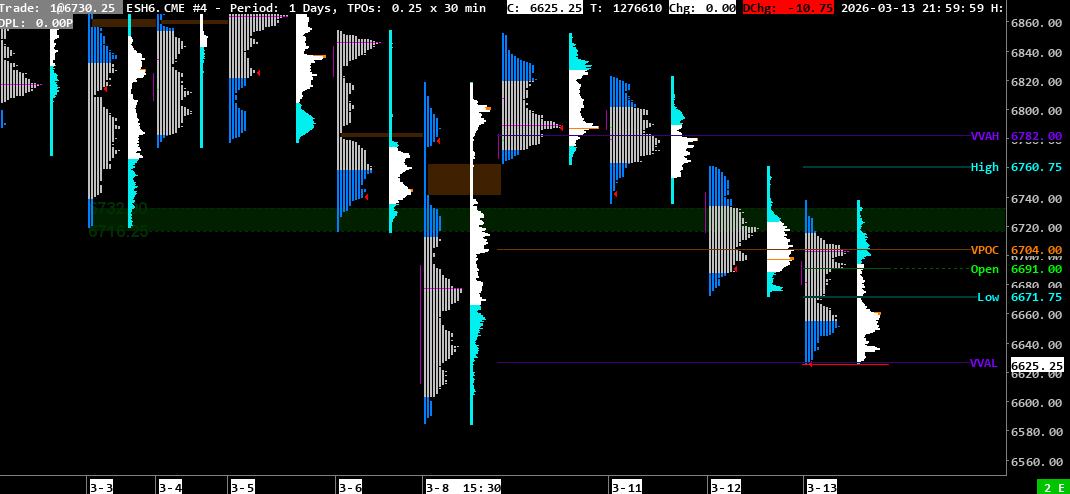
VPOC: 6704
LOW-HIGH: 6584.50-6852.25
VVA: 6627-6782
We experienced a very volatile week with VIX spikes above 30. For the rest of the week, this fear index fluctuated around 25.
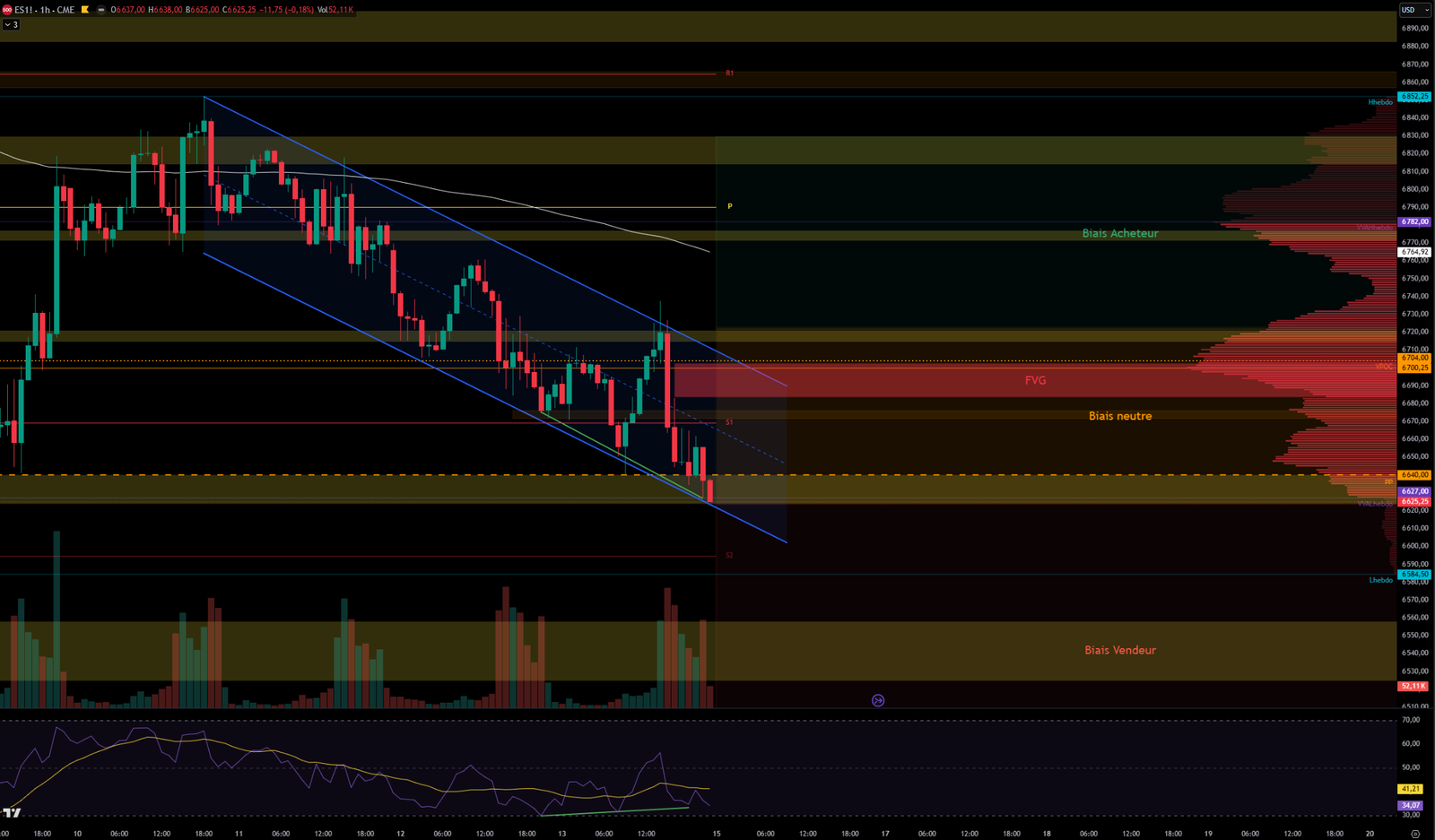
The S&P 500 opened with a large downward gap at 6693 amid the escalating conflict in the Middle East, causing energy prices to soar. Despite this, the US index managed to fill this gap the same day to reach the 6815-6830 resistance zone.
The price spent half the week consolidating between this resistance zone and the 6771-6777 support zone before heading lower and forming a descending channel for the remainder of the week.
The price ended the week at the 6625-6640 support zone, right on the lower line of the descending channel and practically at the early week lows. This intersection between the descending channel and support could constitute a technical bounce zone before continuing its decline, unless the price manages to bounce enough to break the top of this channel.
This bounce could be confirmed by the bullish divergence present on the 1h chart if the latter is validated by a break of the neutrality zone. However, it will take significant strength to bounce, as the S&P 500 created a Fair Value Gap between 6683 and 6700 during its fall. This level also corresponds to the weekly VPOC and a volume low further up.
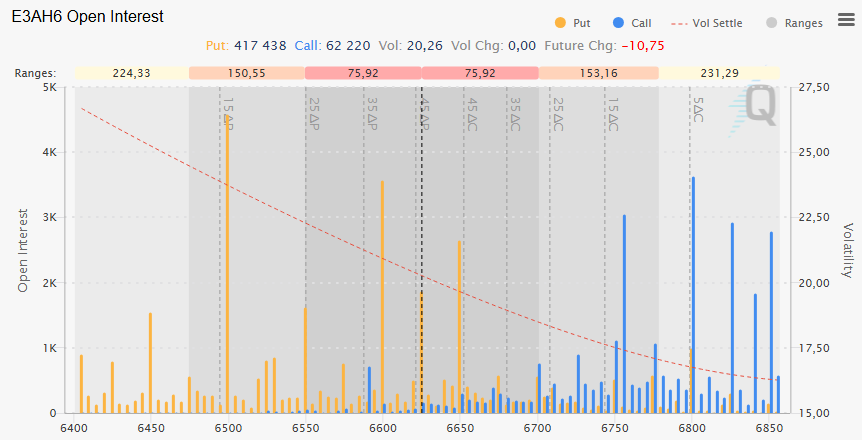
Tomorrow’s open will provide a major indication of the upcoming trend. Regarding option zones, we can observe that investors are mostly hedging for a decline with large put zones at the 6600 and 6500 levels. Calls are situated around the 6800 levels.
Points of Interest
- 6883-6900 (Major resistance zone)
- 6815-6830 (Resistance zone)
- 6782 (Weekly VVAH)
- 6771-6777 (Resistance zone)
- 6715-6720 (Resistance Zone)
- 6624-6640 (Support Zone + Weekly VVAL 6627)
- 6584.50 (Weekly Low)
- 6525-6559 (Major Support Zone)
- 6444-6462 (Support Zone)
Overall Bearish Sentiment








0 Comments