
The Eye of the Storm
Economic Announcements:
- 12:30 PM: Factory Orders
- 2:30 PM: NFP Employment
(Learn more)
Earnings Reports:
No update
Analysis:
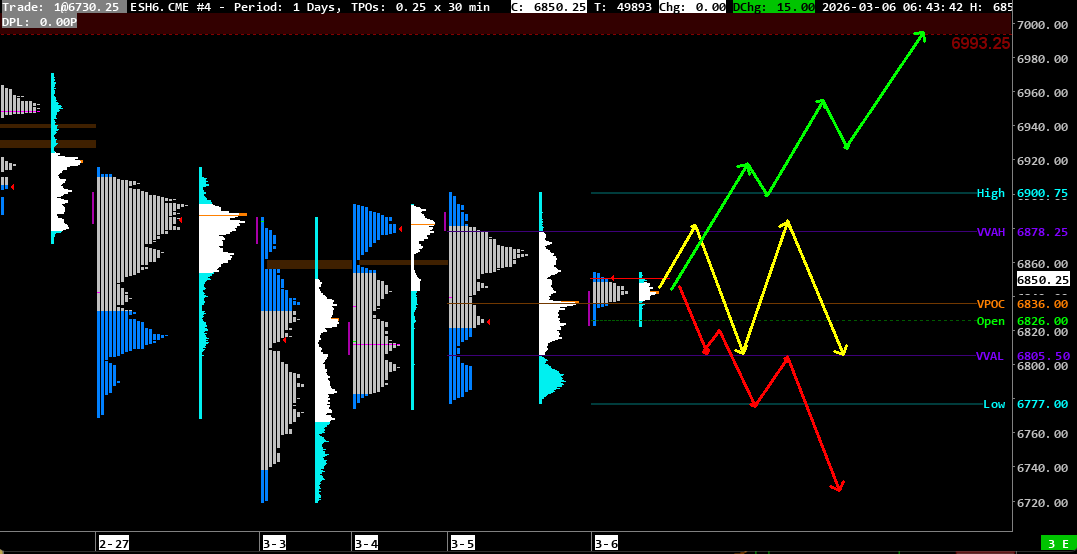
VPOC: 6836
VAL: 6805.50-6878.25
High-Low: 6777-6900.75
PP: 6840
Open: 6826 (Zone 1)
VIX: 22.23
SP500 Trend: Neutral 🟠to Bullish 🟢
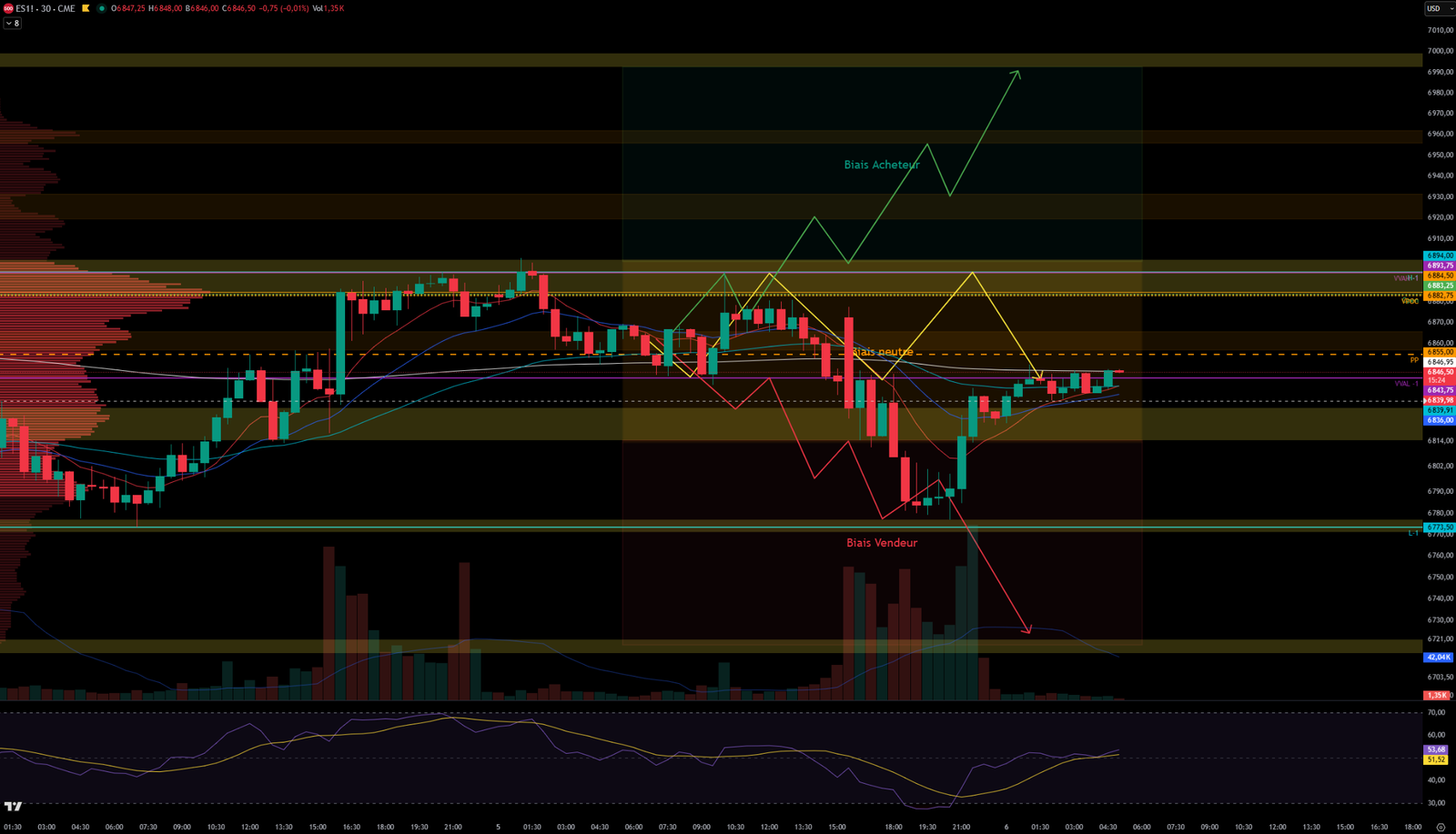
Yesterday, the S&P 500 opened below the resistance zone of 6883-6900 with buyer dominance attempting a breakout above 6900 and VVAH-1. Sellers blocked this advance and pushed the price back to the support zone of 6857-6866 and VVAL-1 at 6843. The price then moved within the previous day’s value area, showing price acceptance throughout the morning.
At the US open, after some balanced trading, sellers took control and brought the price, following a battle at the support zone of 6815-6830, to the support zone of 6771-6777. The price then remained above this support for an extended period before climbing back in the evening to the resistance of 6815-6830, closing around 6825 on the weekly VWAP.
This morning, the S&P 500 opens in zone 1 at 6826 and is trading around the weekly VWAP and VPOC-1. Forces are relatively balanced at the moment. The price could consolidate until this afternoon ahead of NFP data at 2:30 PM.
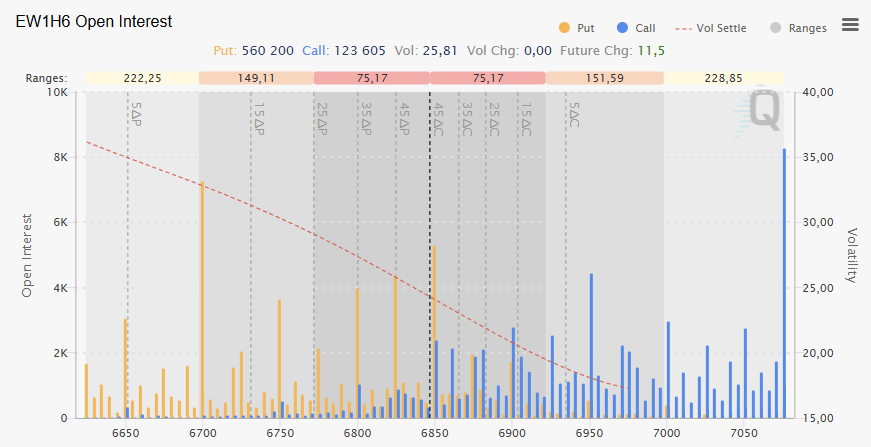
On the options board, we can still see a large concentration of Puts at 6850 and especially at 6700, which could establish our floor in the event of a sharp decline. Calls are also present at 6950 but especially at 7075, which could be the distant target in the event of a significant rally.
Today, we will have NFP data followed by several Fed speeches in the evening.
Volatility remains elevated with the VIX above 22, so exercise caution!
Scenario 1 🟡: On rejection at the resistance zone of 6883-6900, the price could consolidate between this zone and VVAL-1 at 6805, especially ahead of NFP data.
Scenario 2 🟢: On a break of the resistance zone of 6883-6900 and confirmation by breaking yesterday’s high at 6900.75, the price could move higher with 7000 in sight.
Scenario 3 🔴: On a break of the support zone of 6815-6830 and confirmation by breaking VVAL-1 at 6805, the price could move lower to test yesterday’s lows at 6777 then the support zone of 6715-6720.
Zones of Interest:
- 7030-7043 (Major resistance zone + ATH 7043)
- 6993-7000 (Resistance Zone)
- 6957-6962 (Resistance zone)
- 6920-6930 (Resistance zone)
- 6883-6900 (Resistance zone + Yesterday’s high)
- 6878.25 (VVAH-1)
- 6857-6866 (Resistance zone)
- 6815-6830 (Support zone + open 6826)
- 6805.50 (VVAL-1)
- 6771-6777 (Support zone + Yesterday’s low)
- 6715-6720 (Support Zone)
60-second Chrono

Overall Market Situation
Despite a previous close lower in equities related to inflationary concerns, the overall sentiment is improving. Markets are anticipating a provisional end to this particularly dramatic and volatile week. Asian equity markets, after opening down more than 1%, are now trading sharply higher.
Financial Indicators and Currencies
Markets are showing mixed movements between commodities and currencies:
- Commodities (Oil): WTI crude is down 96 cents at $80.04. Brent experienced high volatility, falling to $83.16 before steadily rebounding to $84.47.
- Commodities (Metals): Precious metals are shining in the latest session: gold is up more than 1% at +$57 and silver is advancing nearly 3%.
Note: gold remains down for the week, with massive selling in Europe and the United States outweighing Asian buying. - Currencies: The Australian dollar (AUD) is leading the way, while the US dollar (USD) is lagging, experiencing modest broad-based selling.
- Indices and Bonds: Japan’s Nikkei is up 0.5%. On the bond side, US 10-year yields fell 1.2 basis points to 4.14%.
Geopolitics and Middle East Conflict
Although the conflict has pushed investors toward safe-haven assets and impacted the airline sector, signs of diplomatic and military de-escalation are emerging:
- Maritime security: China is pressuring Iran to allow LNG vessels to pass through the Strait of Hormuz.
- Reduced military tensions: A US admiral reports that Iranian ballistic missile attacks have decreased by 90%.
- US Diplomacy: The United States has granted Iran a 30-day sanctions waiver to purchase Russian crude, signaling a desire to limit oil price spikes. Additionally, Donald Trump claims that Iran is seeking guidance to negotiate a deal, indicating a willingness to avoid escalation in the short term.
Federal Reserve Interventions
Monetary policy officials continue to scrutinize the economy:
- Several officials will speak in New York regarding the impact of private sector data on monetary policy.
- Austan Goolsbee (Chicago Fed) notably emphasized that institutions are currently facing a genuine “crisis of confidence.”
Corporate Performance and Investments
- Costco: Exceeded earnings expectations, although the stock reaction remained muted.
- Sovereign wealth funds: According to some reports, Gulf states may be reviewing their overseas investments.
- Broadcom: Announces strong demand for its AI chips, forecasting over $100 billion in sales.
- Berkshire Hathaway: Resumes share buybacks after a two-year pause.
- Oracle and Kroger: Oracle is considering job cuts related to data center costs, while Kroger anticipates a decline in sales while focusing on low prices to capture market share.
US Employment Report
Forecasts indicate an increase of 59,000 nonfarm payrolls in February, marking a slowdown after the strong gain of 130,000 in January. The unemployment rate is expected to remain stable at 4.3%.
Macro

US Economy: Labor Market Holds Firm, but Surge in Wage Costs Revives Inflationary Concerns
Employment: A Two-Speed Market
Weekly Unemployment Claims:
Actual: 213K
Forecast: 215K
Previous: 213K
Regular Unemployment Benefit Recipients:
Actual: 1868K
Forecast: 1850K
Previous: 1822K
-> This is a double-edged dynamic. On one hand, companies are laying off few workers. But on the other, the continued and stronger-than-expected increase in continuing claims proves that those who lose their jobs are taking much longer to find new ones. The market is cooling through a hiring freeze, not through waves of layoffs.
Productivity and Labor Costs: The Unwelcome Surprise for the Fed
Nonfarm Productivity (Quarterly):
Actual: 2.8%
Forecast: 1.9%
Previous: 5.2%
Unit Labor Cost (Quarterly):
Actual: 2.8%
Forecast: 2.0%
Previous: -1.8%
-> This is the pressure point of this release. While productivity surprises very positively to the upside, the spectacular jump in unit labor cost is very bad macroeconomic news. A wage cost increase well above expectations is the perfect fuel for “sticky” inflation. This is exactly what the Fed is tracking and fears.
Foreign Trade: Mixed Signals at the Borders
Import Price Index (Monthly) (Jan.):
Actual: 0.2%
Forecast: 0.3%
Previous: 0.2%
Export Price Index (Monthly) (Jan.):
Actual: 0.6%
Forecast: 0.3%
Previous: 0.6%
-> A contrasting situation. Import prices are below expectations, providing slight relief for American consumers (imported disinflation). However, the very strong surprise acceleration in export prices (double the consensus) shows that pressures on US producer prices remain intense.
Summary
The Specter of the Price-Wage Loop: The sharp 2.8% increase in unit labor cost is the real warning signal from this calendar. Even supported by strong productivity, if wage costs are becoming increasingly expensive for companies, the risk is that they pass these increases on to selling prices to protect their margins. This is a major inflationary factor.
The Fed Reinforced in Its Caution: With companies refusing to lay off workers en masse and wage costs accelerating, the Federal Reserve has no reason to ease pressure. These statistics provide solid arguments for maintaining a restrictive monetary policy and keeping rates elevated longer than expected to definitively break this wage dynamic.






0 Comments