
The FED is the focus
Economic Announcements:
Earnings Reports:
S&P 500 Analysis:
⚠️Contract Change June 2026
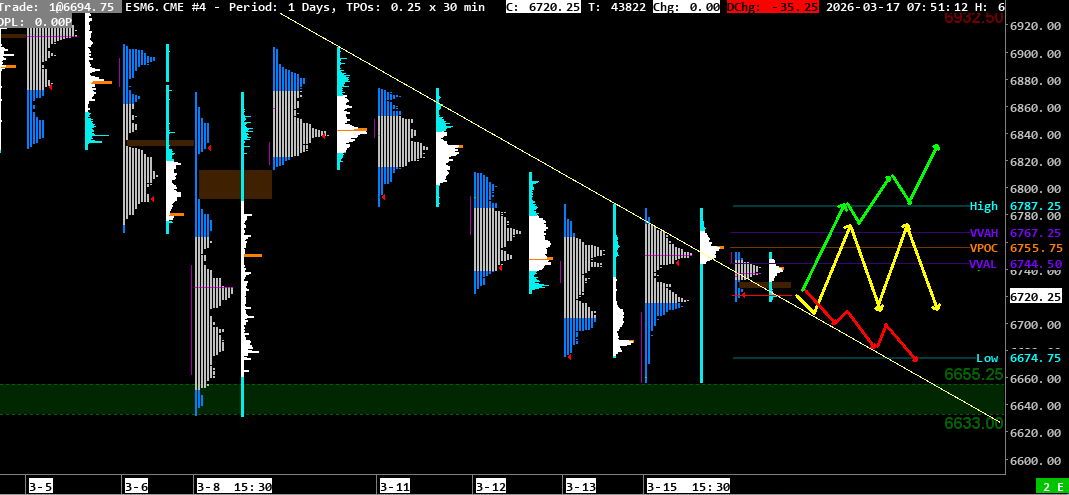
VPOC: 6755.75
VVA: 6744.50-6767.25
High-Low: 6655-6787.25
PP: 6730
Open: 6744.25
Vix: 24.20
SP500 Trend: Overall Bearish Sentiment 🔴
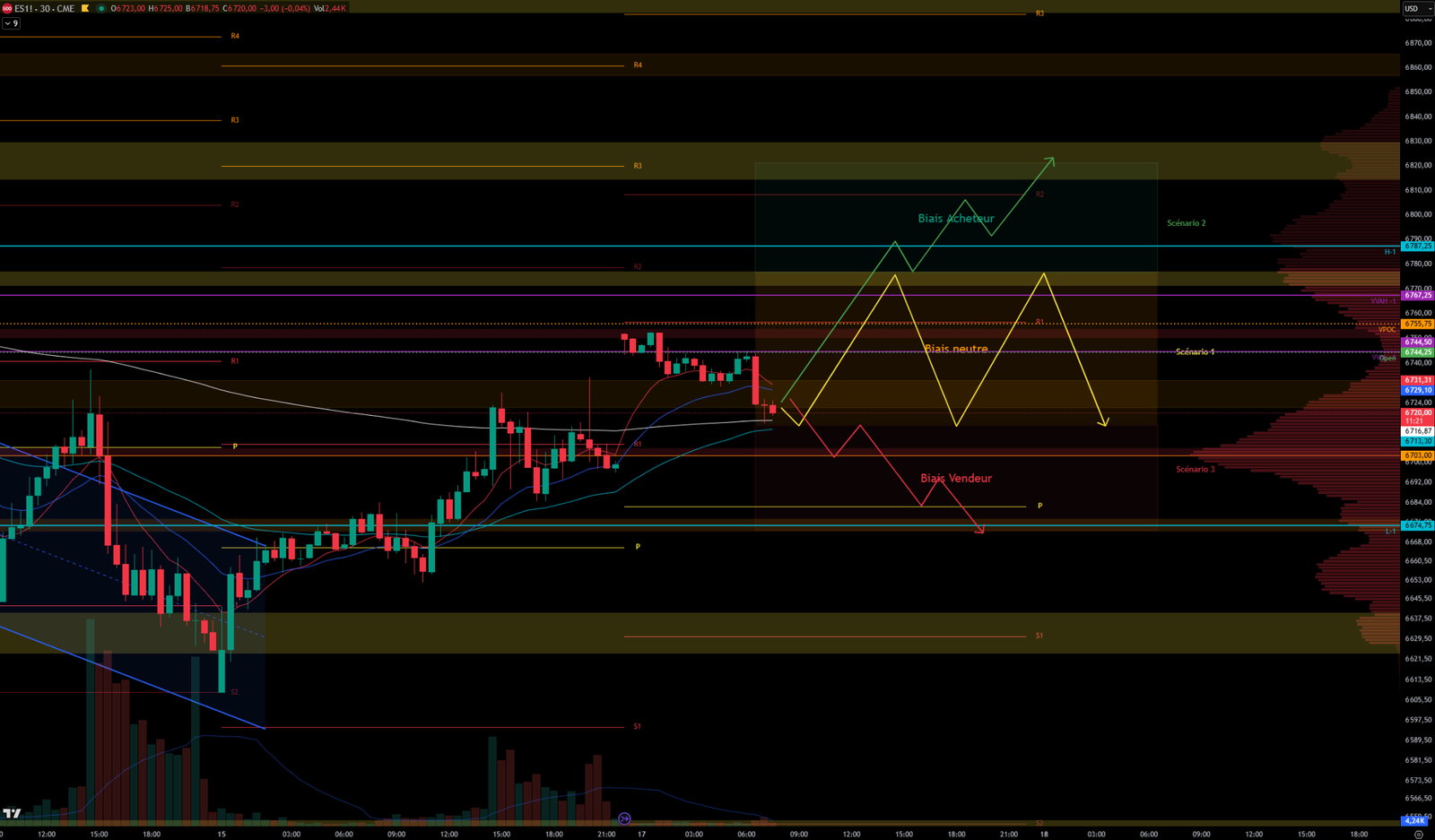
Yesterday, the S&P500 opened in the lower zone 3 but quickly re-entered the previous day’s value area. Buyers took control and pushed the price up to the 6722-6733 resistance, where it remained for a good part of the morning before breaking this resistance prior to the US open.
At the US open, buyers maintained control and attempted to push the price higher but were stopped at the 6770-6775 resistance. The price then consolidated throughout the afternoon between the 6722-6733 support and the 6770-6775 resistance. This morning, the index opens in zone 1 at 6744.25, on VVAL-1 and on the 6750-6755 resistance zone. Sellers are in control and have pushed the price below the 6722-6733 support zone. Indicators are predominantly bearish for now, as is the cumulative delta.
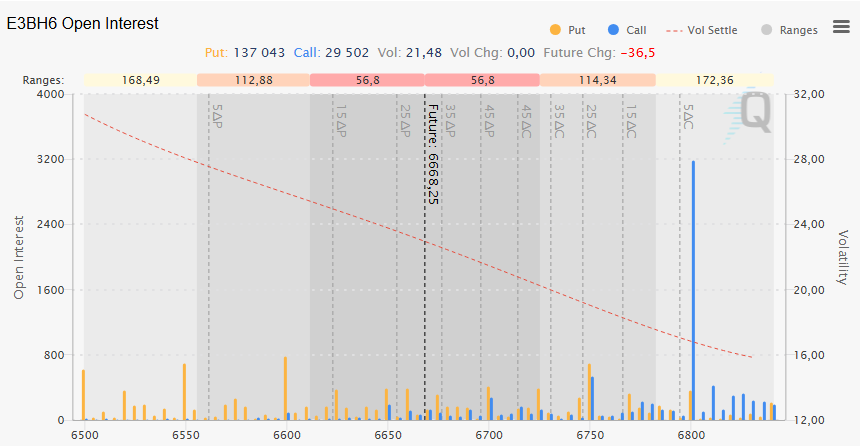
This morning, levels are higher than normal, and volatility remains at 24. Caution will be required when entering positions, and stop placement should be adjusted accordingly. In terms of options, we see significant call interest at 6800, which could attract the price but also cap it at that level.
Today, we will have pending home sales data and the ongoing FED meeting, which is expected to announce its decision on interest rates, which are not anticipated to change.
Scenario 1 🟡: Upon rejection at the 6722-6733 resistance zone, the price could consolidate between this support and the 6771-6777 resistance zone.
Scenario 2 🔴: Upon breaking the 6722-6733 zone, the price could decline and seek the 6700-6705 support zone, then the 6673-6677 zone.
Scenario 3🟢: Upon breaking the 6771-6777 resistance zone, the price could continue its ascent and target the 6800 zone.
Zones of Interest:
- 6883-6900 (Resistance zone)
- 6815-6830 (Resistance zone)
- 6722-6733 (Resistance Zone)
- 6700-6705 (Support Zone)
- 6673-6677 (Support Zone + Previous Day’s Low)
- 6625-6640 (Support zone)
60-second Chrono

Market situation
Wall Street closed sharply higher, boosted by gains in artificial intelligence-related stocks. Meanwhile, oil prices retreated, with Brent falling below the $100 mark (to $99.79 per barrel), following the announcement that some ships were able to cross the Strait of Hormuz.
Economic Data
U.S. industrial production increased by 0.2% in February. Additionally, the capacity utilization rate for the industrial sector remained stable at 76.3%.
Builder Sentiment
The NAHB/Wells Fargo Housing Market Index (HMI) rose slightly by one point to 38 in March, remaining below the breakeven point of 50 for the 23rd consecutive month.
Upcoming Events
The FED is holding its monetary policy meeting this week, and expectations point to a maintenance of interest rates between 3.5% and 3.75%. This week is described as historic because the four major central banks (Fed, ECB, BoE, BoJ) are meeting simultaneously.
Market Volatility
Stocks have recently suffered from oil-related volatility, with the S&P 500 recording a weekly decline of 1.6% and its first three-week losing streak in about a year. However, sentiment has improved in the short term with a recent rebound in indices, although uncertainty related to the Middle East conflict continues to weigh heavily.
Impact of the Iran War
The conflict has significantly disrupted the energy market, threatening one-fifth of the world’s oil supply. The attack on the Fujairah oil port forced the United Arab Emirates to cut its production by more than half. Fears of a prolonged economic shock remain if the situation escalates.
Currency Reaction
The U.S. dollar retreated this week against other currencies (such as the euro and the pound sterling) due to improved risk sentiment and falling bond yields. However, it had previously benefited from its safe-haven status since the start of the U.S.-Israeli strikes against Iran.
Inflation Outlook
Inflationary fears persist due to surging energy prices. This price pressure complicates the Fed’s monetary policy forecasts, which may be forced to maintain high rates for longer to avoid a new wave of inflation, thereby rekindling the risk of a stagflationary environment.
Macro

Industry: An Unexpected Halt, New York Manufacturing Stalls
New York Fed Empire State Manufacturing Index (March):
- Current: -0.20
- Forecast: 4.00
- Previous: 7.10
-> This is a notable disappointment for the American industrial sector. The index sharply plunges into negative territory. Not only does the figure significantly miss the consensus, which anticipated continued growth, but it also erases the strong momentum of the previous month. Manufacturing activity in the New York region is suddenly contracting, reflecting a slowdown among purchasing managers, orders, and factory production.
Summary
- The first industrial domino to falter? Although the U.S. economy is generally very robust, the manufacturing sector is often the first to show signs of fatigue in the event of a slowdown.
- Impact for the FED: For the market, a ‘bad’ macroeconomic news item of this type limits fears of overheating. Industrial weakness provides the Federal Reserve with an argument not to further tighten its policy, or even to justify future rate cuts if the trend worsens.






0 Comments