
Black or yellow gold?
Economic Announcements:
- 3:45 PM: Manufacturing PMI
- 4:00 PM: ISM Manufacturing
Earnings Reports:
- The AES (AES)
- Norwegian Cruise Line (NCLH)
Analysis:
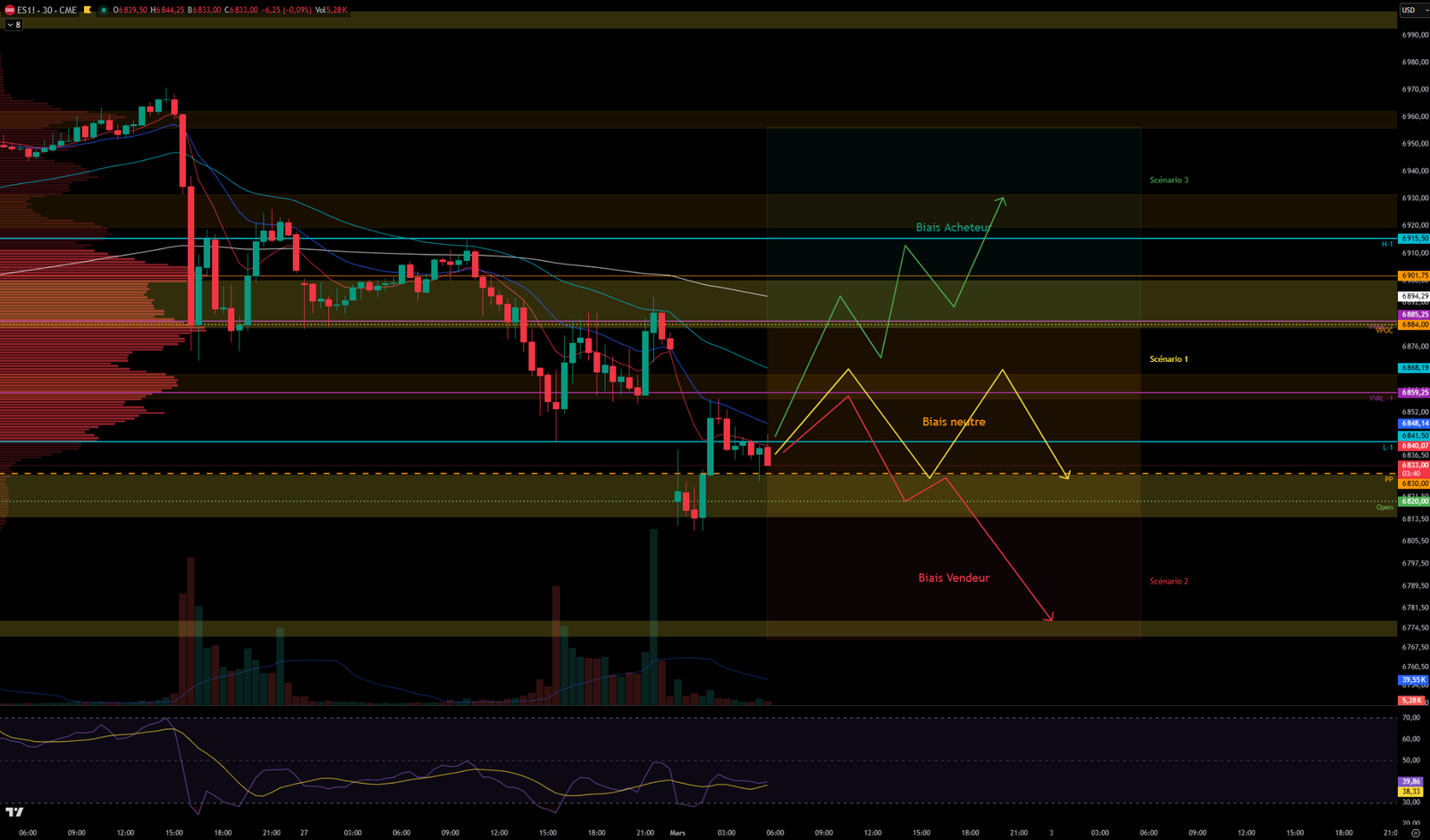
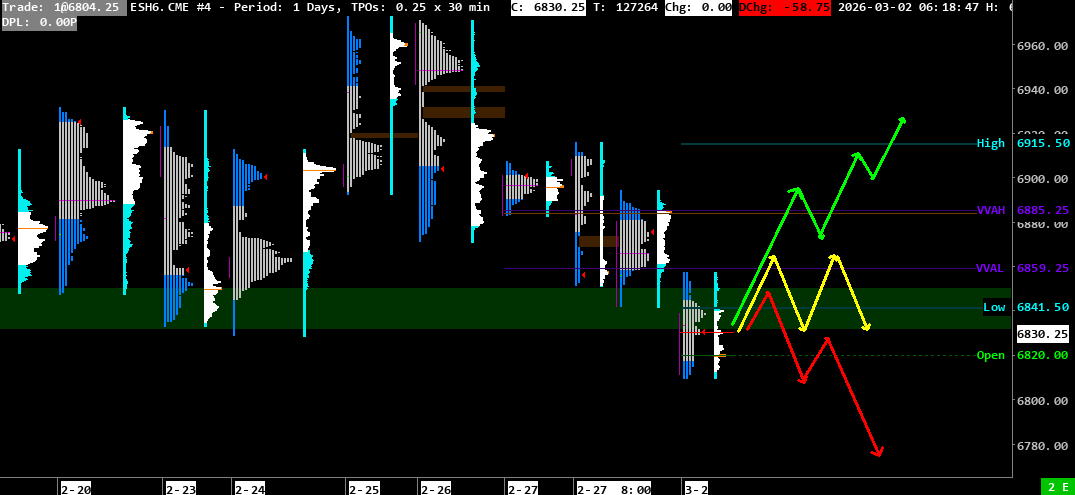
VPOC: 6884
VVA: 6859.25-6885.25
High-Low: 6841.50-6915.50
PP: 6830
Open: 6820 (Zone 3)
Vix: 19.85
SP 500 Trend: Overall sentiment neutral 🟠 to bearish 🔴
On Friday, the S 500 spent the morning around the 6883-6900 resistance zone with a slight bullish trend until 10:00 AM. From 10:20 AM, sellers took control and pushed the price below the 6883-6900 support zone. Following the inflation data announcement, sellers provided a new bearish impulse, sending the index below the 6857-6866 support zone. Below this level, buyers were present and defended the level throughout the day.
At the US open, both parties found common ground, with the price consolidating between the 6857-6866 support zone and the 6883-6900 resistance zone. The price then closed at 6883.
This morning, the US index opened with a bearish gap in Zone 3 at 6820 amid a complicated context of war between the United States and Iran. WTI crude oil rose nearly 6%, and Treasury bonds as well as gold increased. The price opened just above the 6815-6830 support zone and even attempted to break through it, but buyers defended the zone, pushing the price back up to the 6857-6866 resistance zone. Both parties seem to have agreed on a price for the time being during the Asian session.
With this bearish gap, the bullish divergence on the 1h chart is invalidated, which could confirm a continuation of the decline. Furthermore, the RSI is in the selling zone across all timeframes.
Volumes are already very high this morning, at nearly three times the usual volume. You will need to be mindful of volatility today, as even the slightest news could ignite the markets.
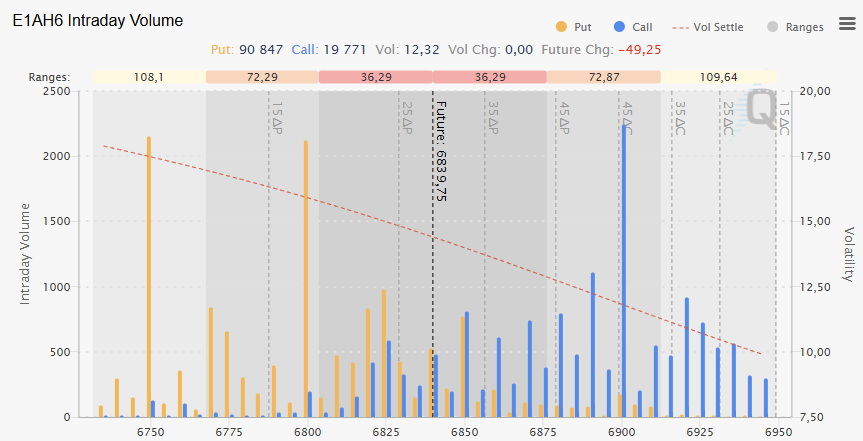
On the options table, we observe a large call zone at 6900 and put zones at 6800 and 6750. The market could navigate between these boundaries today.
It will also be necessary to keep an eye on WTI, as oil is negatively correlated with the SP. You should not go long if oil continues to rise.
Today, we will have the Manufacturing PMI and ISM PMI data.
Scenario 1 🟡: Upon rejection of the 6815-6830 support zone, the price could consolidate above this support and within the 6857-6866 resistance zone.
Scenario 2 🔴: Upon a break of the 6815-6830 support zone, the price could target 6800 and then the 6771-6777 support zone.
Scenario 3 🟢: Upon a break of the 6857-6866 resistance zone, the price could fill this morning’s bearish GAP between 6857 and 6873 and target the 6883-6900 resistance zone, which will be difficult to cross given Friday’s VPOC and VVAH. If successful, it could target the 6920-6930 resistance zone.
Zones of Interest:
- 6993-7000 (Resistance Zone)
- 6956-6963 (Resistance Zone)
- 6920-6930 (Resistance Zone)
- 6915 (Friday High)
- 6983-6900 (Resistance Zone + VPOC 6884 + VVAH-1 6885)
- 6857-6866 (Resistance Zone + VVAL-1 6859)
- 6841 (Friday Low)
- 6815-6830 (Support Zone + Open 6820)
- 6800 (Major Put Zone)
- 6771-6777 (Support Zone)
- 6715-6720 (Support Zone)
60-second Chrono

Market Performance
Wall Street experienced a decline, particularly in the technology and financial sectors, due to concerns regarding costs and disruptions related to artificial intelligence (AI). The SP 500 fell 0.43%, the Dow Jones 1.05%, and the Nasdaq 0.92%.
Commodity Markets
Gold prices rose, supported by lower Treasury bond yields, while the dollar decreased. Oil also saw an increase due to geopolitical tensions and supply risks, notably between the United States and Iran.
Upcoming Economic Data
The Institute for Supply Management (ISM) forecasts a decline in the Manufacturing PMI for February to 51.8, down from 52.6 the previous month. Non-farm payroll forecasts indicate the creation of 60,000 jobs in February, marking a slowdown from the 130,000 jobs created in January.
Company Earnings
Several companies, including Costco and Target, are scheduled to release their financial results this week. Investors will take a particular interest in the impact of tariff uncertainties on consumer sentiment, supply chain management, and annual forecasts.
Artificial Intelligence Trends
Concerns regarding AI-related disruptions continue to weigh on the market and keep investors on edge. Estimates suggest that AI has already been responsible for significant job losses in the most exposed sectors during 2025.
The Middle East This Morning

Conflict Escalation: Strikes and Retaliation
Military strikes against Iran, initially planned for the previous week, were delayed. Iran is now retaliating by attacking US targets, which exacerbates tensions and spreads the conflict to other regions. This climate of uncertainty is fueling nervousness in the financial markets.
Impact on the Oil Market: WTI Volatility
Crude prices saw a sharp rise, with WTI exceeding $75 before stabilizing around $71. This volatility reflects the initial panic of traders facing major geopolitical risk.
Supply Disruption: The Strait of Hormuz Factor
The Strait of Hormuz is the critical chokepoint for oil transit (20% of global supply). Although it is not completely closed, the fear of Iranian attacks is forcing ships to reroute, creating a logistical bottleneck and a reduction in available supply.
Supply Glut: Structural Supply Remains Strong
Despite the escalation, the market faces a structural surplus. Forecasts indicate that this abundant supply could keep prices around $60 in the longer term once the war risk premium evaporates.
OPEC+ Reactions: Production Increase
In a strategic move, OPEC+ has decided to increase production. This decision appears to be a direct response to US-Iranian tensions, aimed at stabilizing prices and offsetting potential cuts from Iran.
US Shale Production: The Role of the USA
Shale producers in the United States could take advantage of rising prices to intensify production. However, their ability to react quickly remains limited in the face of the massive impact that a prolonged closure of the Strait of Hormuz would represent.
Conclusion: Between Initial Shock and Market Realities
The market is currently benefiting from an “emotional shock.” Once the situation stabilizes or is “priced in,” traders will refocus on the excess supply. This could create selling opportunities for oil if the tension does not escalate into total war.
Macro

Inflation and US Activity: An Overheating Economy
Overall and “Core” Producer Price Index (PPI) (January):
- Actual: 0.5% (Overall) / 0.8% (Core)
- Forecast: 0.3% (Overall) / 0.3% (Core)
- Previous: 0.4% (Overall) / 0.6% (Core)
-> This is a powerful warning signal regarding inflation. Prices charged by producers at the factory gate are rising much faster than expected. The “Core” figure is particularly high at 0.8%. This proves that inflation is stubborn at the source, which will mechanically end up being passed on to consumers in the coming months.
Chicago PMI (Feb.) Construction Spending (Dec.):
- Actual: 57.7 (PMI) / 0.3% (Construction)
- Forecast: 52.0 / 0.2%
- Previous: 54.0 / -0.1%
-> These figures confirm that the US economy is extremely robust. The Chicago PMI jumped well above the 50 mark, indicating a strong acceleration in business activity. Construction spending is also rising again. The economy refuses to slow down.
Summary
A Propelled Dollar, Indices Under Pressure: We have here the perfect cocktail to trigger market reactions. On one hand, “producer” inflation is rebounding strongly; on the other, an economy running at full speed. The conclusion is clear: the Federal Reserve (Fed) is in no hurry to lower interest rates.






0 Comments