
Powell at the wheel,
VIX at the turning point
Economic Announcements:
- 1:30 PM : PPI
- 3:30 PM: Crude oil inventories
- 7:00 PM: FED interest rate decision
- 7:30 PM: FOMC press conference
Earnings Reports:
S&P 500 Analysis:
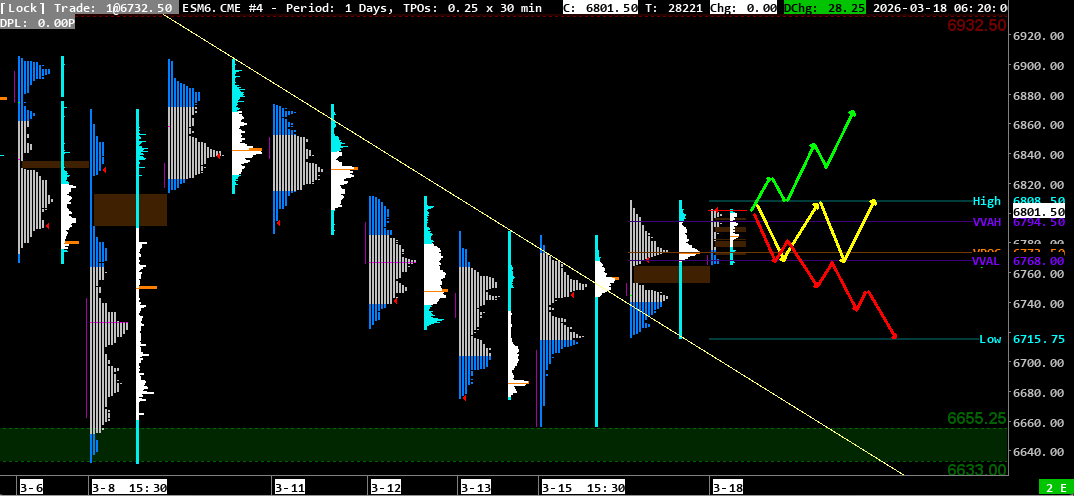
VPOC: 6773.50
VVA: 6768 – 6794.25
High-Low: 6715.75 – 6808.50
PP: 6765
Open: 6768.25 (Zone 1)
VIX: 23.43
SP500 trend: Overall sentiment neutral 🟠 to bullish 🟢
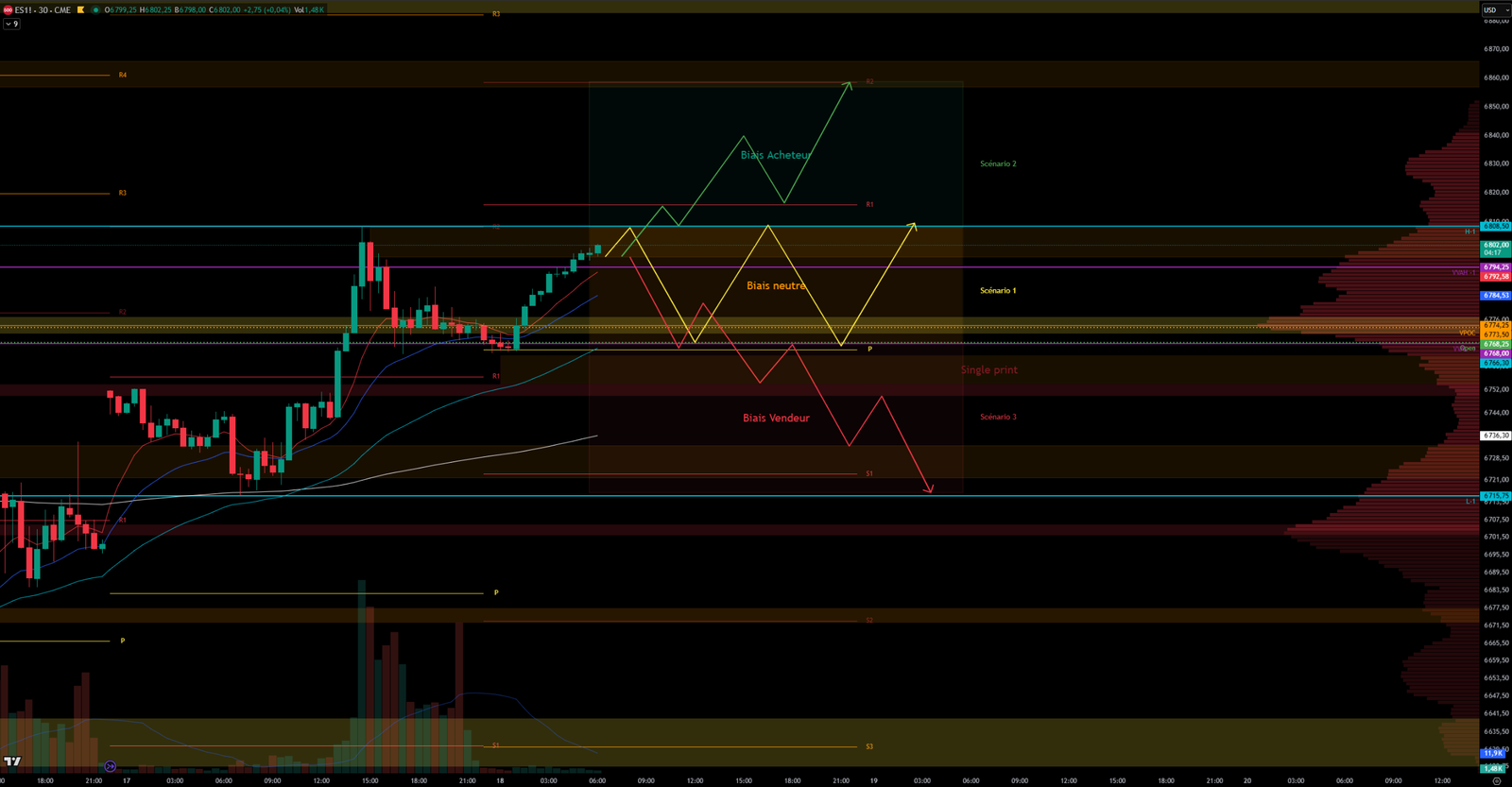
Yesterday, the S&P 500 had a volatile morning, opening in the 6750–6755 resistance zone. Sellers took control and pushed price down to the 6722–6733 resistance area. Buyers defended the zone and took over, holding control until the US open. Buyers then pushed price sharply up to the prior day’s high at 6787.
At the US open, buyers tried to extend the move higher but were stopped by sellers at the 6798–6808 resistance level. Price then moved lower and settled on the 6771–6777 support zone, just above the prior day’s value area, and stayed there until the close.
On the 1-hour chart, price moved back above the 200 moving average, which is a positive sign for a sustained bullish recovery. In addition, during the rally, the S&P 500 created a single print between 6754 and 6764, which will serve as solid support just below the VVAL-1.
Since the start of the week, Cash sessions have been relatively calm compared with the pre-market and have not offered many opportunities, but that could change today with the PPI, crude oil inventories, and the FOMC statement.
Today, the US index opens in Zone 1 at 6768.25, just above the prior day’s VVAL. Sellers attempted to break out of the value area but were stopped by buyers, who took control just above the single print and pushed price into the 6798–6808 resistance zone, where it currently appears to be stabilizing.
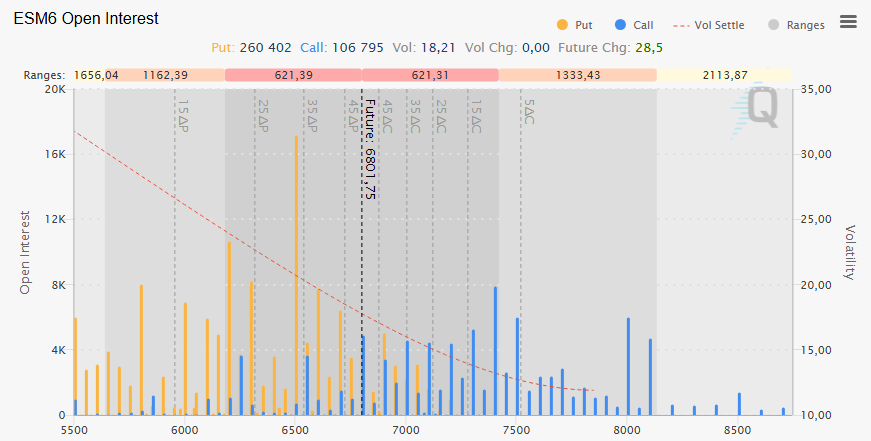
In options, we can see a large put zone around 6500, which may indicate that investors are hedging against a sharp drop in price.
Today we will have the PPI data at 1:30 PM, crude oil inventories at 3:30 PM, and, most importantly, the FED interest rate decision at 7:00 PM, followed by Powell’s speech at 7:30 PM, which will have a crucial impact on the markets.
Scenario 1 🟡: On a rejection from the 6798-6808 resistance zone and yesterday’s high at 6808.50, price could consolidate between that resistance and the bottom of the value area at 6768. This scenario may remain valid until this afternoon’s announcements.
Scenario 2 🟢: On a breakout above the 6798-6808 resistance zone, price could move toward the 6856-6866 resistance zone.
Scenario 3 🔴: On a break below the VVAL-1 and a fill of the single print at 6754-6764, price could target the 6722-6733 support zone, then yesterday’s low at 6715.
Zones of Interest:
- 6856-6866 (Resistance zone)
- 6798-6808 (Resistance zone + prior day’s high 6808.50)
- 6771-6777 (Support Zone)
- 6754-6764 (Single Print)
- 6750-6754 (Support zone)
- 6722-6733 (Support zone)
- 6715.75 (Prior day’s low)
- 6703-6706 (Support zone)
- 6673-6677 (Support zone)
60-second Chrono

Market Situation & Tech Sector
- Positive close: US indices finished higher for the second consecutive session. The S&P 500 gained 0.25%, while the Russell 2000 led the way with a 0.67% advance, signaling a stronger risk appetite.
- Amazon’s AI rebound: Amazon shares rebounded 1.66% ($215.25) following comments from CEO Andy Jassy. He expects AI could propel AWS revenue to $600 billion by 2036. Technically, the stock is back above its 100- and 200-hour moving averages, giving buyers the upper hand in the short term.
Today’s catalyst: the FED (7:00 PM)
- Status quo expected: Rates are expected to be kept between 3.50% and 3.75%.
- The real risk (Powell at 7:30 PM): The market fears the specter of stagflation. Powell is expected to adopt a very cautious stance in the face of a resilient economy and inflation reignited by energy prices.
Oil and geopolitics
- Energy under pressure: Oil remains very elevated (WTI around $94.69). The geopolitical risk premium is being sustained by strikes near nuclear infrastructure (Bushehr) in Iran.
- Modest relief: An Iraq/Kurdistan agreement allows some oil exports to resume by bypassing the Strait of Hormuz, avoiding—for now—an acceleration in prices toward $100 on WTI.
Macroeconomics and fundamentals
- US resilience: The US economy is not cracking. Home sales surprised to the upside (+1.8%), giving the Fed arguments not to cut rates.
- Tech & Risk: The market closed in the green yesterday, supported by small caps and a rebound in Tech (Amazon boosted by AI).
- Global pressure: Inflation is hitting everywhere. Australia surprised overnight by raising rates to 4.10%, and Japan is preparing to tighten its monetary policy.
- Upcoming economic data: We are awaiting data on the PPI (producer prices) and factory orders, with forecasts pointing to a moderate rise in prices.
Forex (EUR/USD)
The euro’s rebound is facing the key technical test: price is testing the 200-hour moving average at 1.15499. A breakout would confirm a genuine buying recovery against the dollar.
Macro

Real estate: A spectacular rebound as the US market defies forecasts Pending Home Sales (MoM) (Feb.):
- Actual: 1.8%
- Forecast: -0.6%
- Previous: -1.0%
-> This is a major and positive surprise for the US real estate sector. The indicator has surged back into positive territory. Not only does the figure decisively beat the consensus, which had expected another contraction, but it also completely reverses the previous month’s negative momentum. Contract signings rebounded suddenly, reflecting an unexpected strong return of buyers to the market.
Summary
- The resilience of US real estate? Real estate is a pillar of the economy and a sector that is extremely sensitive to interest rates. This surprise rebound shows that despite financing conditions that remain restrictive, underlying demand from US households is extremely robust. Buyers appear to be adapting to the environment.
- Impact for the FED: Such strength in real estate shows that the economy is not slowing. This gives the FED a strong argument to keep interest rates higher for longer. For financial markets, this generally cools hopes of imminent rate cuts, which tends to support the US dollar (USD) but can put pressure on equities.






0 Comments