
Enough is enough!
Macro

The week began with signals of strong economic resilience, driven by an unexpected acceleration in the manufacturing sector, where indices remained solidly above expectations (ISM at 52.4). However, an inflation warning sign flashed immediately with the explosion of the prices paid index to 70.5, reflecting a sharp rise in supply costs.
Initially, the private labor market (ADP) was reassuring with 63,000 job creations, and the services sector confirmed its robustness (non-manufacturing ISM rising to 56.1).
However, the situation darkened as the days progressed. While weekly jobless claims remained low (213,000), the continued rise in continuing claims highlighted a slowdown in hiring for those seeking to re-enter the workforce. Tensions escalated on Thursday with unit labor costs, which jumped by 2.8%, reviving the threat of “sticky” wage-driven inflation. Meanwhile, the American consumer showed clear signs of fatigue in the face of rising prices, with retail sales falling by -0.2%.
The final blow came on Friday with the NFP employment report, a true macroeconomic earthquake: the economy unexpectedly shed 92,000 jobs, pushing the unemployment rate to 4.4%.
Worse still, wages continued to climb (+3.8% year-on-year) despite this violent slowdown, embodying the perfect definition of a “stagflationary” environment.
Trapped between collapsing growth and persistent inflationary wage dynamics, the Federal Reserve faces a dilemma. This climate of extreme uncertainty, coupled with the repercussions of the conflict in Iran and the oil shock, led to a violent reduction in risk across the markets.
Summary
- NFP Shock: Sharp and unexpected contraction (NFP shock).
- Inflation and Consumption: A stagflationary environment (persistent wages and declining consumption).
- Stock Indices: A brutal week of declines and strong risk aversion amid recession fears.
News

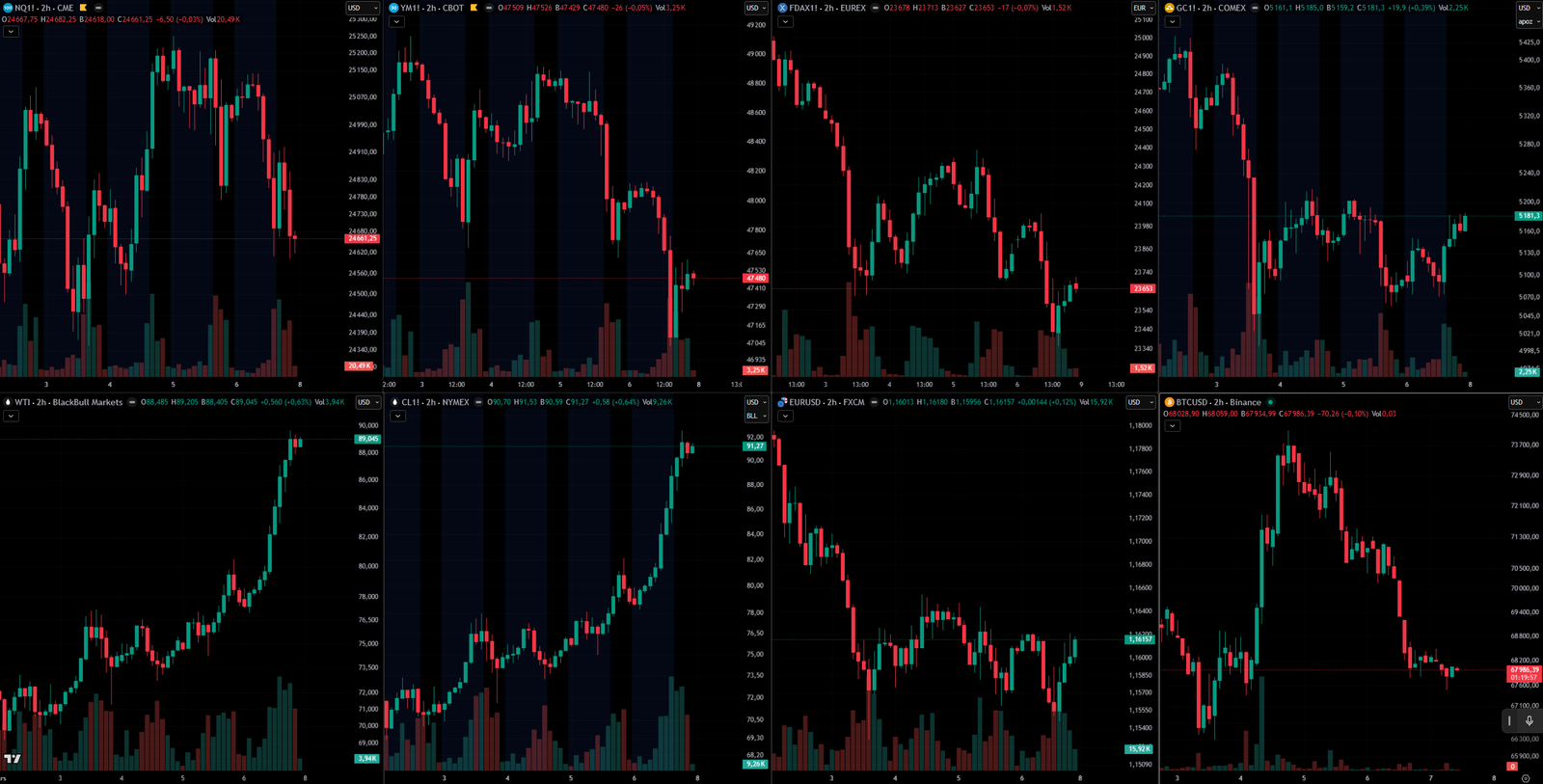
The week was completely dominated by the outbreak of a major regional conflict in the Middle East. On February 28, the United States and Israel launched massive strikes against Iran, notably resulting in the death of Supreme Leader Ali Khamenei. This escalation, marked by Iranian retaliation across the Arabian Peninsula, caused an immediate shock to energy markets. Brent crude surged from $65 to over $90, and gas prices doubled, fueled by fears of disruption in the Strait of Hormuz, through which 20% of the world’s oil passes.
This wartime climate violently reshuffled sectoral cards, pushing investors toward a massive reduction in risk.
The airline sector collapsed under the dual impact of soaring jet fuel prices and the suspension of routes in the Middle East, with heavy losses for Air France (-17.97%) and US carriers.
Conversely, maritime transport benefited from the situation: Maersk shares jumped (+9.06%) on expectations of a sharp rise in freight rates to compensate for bypassing the area. Defense stocks and liquefied natural gas exporters were also among the clear beneficiaries of the crisis.
The technology sector, and particularly semiconductors, underwent a violent correction. In addition to macroeconomic fears, the industry was hit by the announcement of new US restrictions on AI chip exports. These measures, which require strict government approvals for international sales to limit geopolitical risks, sent heavyweights like Nvidia, ASML, Micron, and Arm tumbling.
On the front of other asset classes, industrial commodities are under pressure, with aluminum exceeding $3,400 per ton due to threats to exports and Gulf smelters.
Paradoxically, despite widespread risk aversion, Bitcoin rebounded strongly to move back above $68,000, primarily supported by massive inflows into spot ETFs early in the week.
Summary
- Geopolitics and Energy: Explosion in oil prices (over $90) and gas amid the risk of a Middle East conflagration and the blockage of the Strait of Hormuz.
- Sector Winners and Losers: Sharp drop in airlines (expensive oil, closed airspace), but a surge in maritime transport, LNG exporters, and defense.
- Tech and Crypto: Heavy sell-off in tech and semiconductor stocks following new US restrictions on AI, while Bitcoin resists the decline thanks to ETFs.
Market

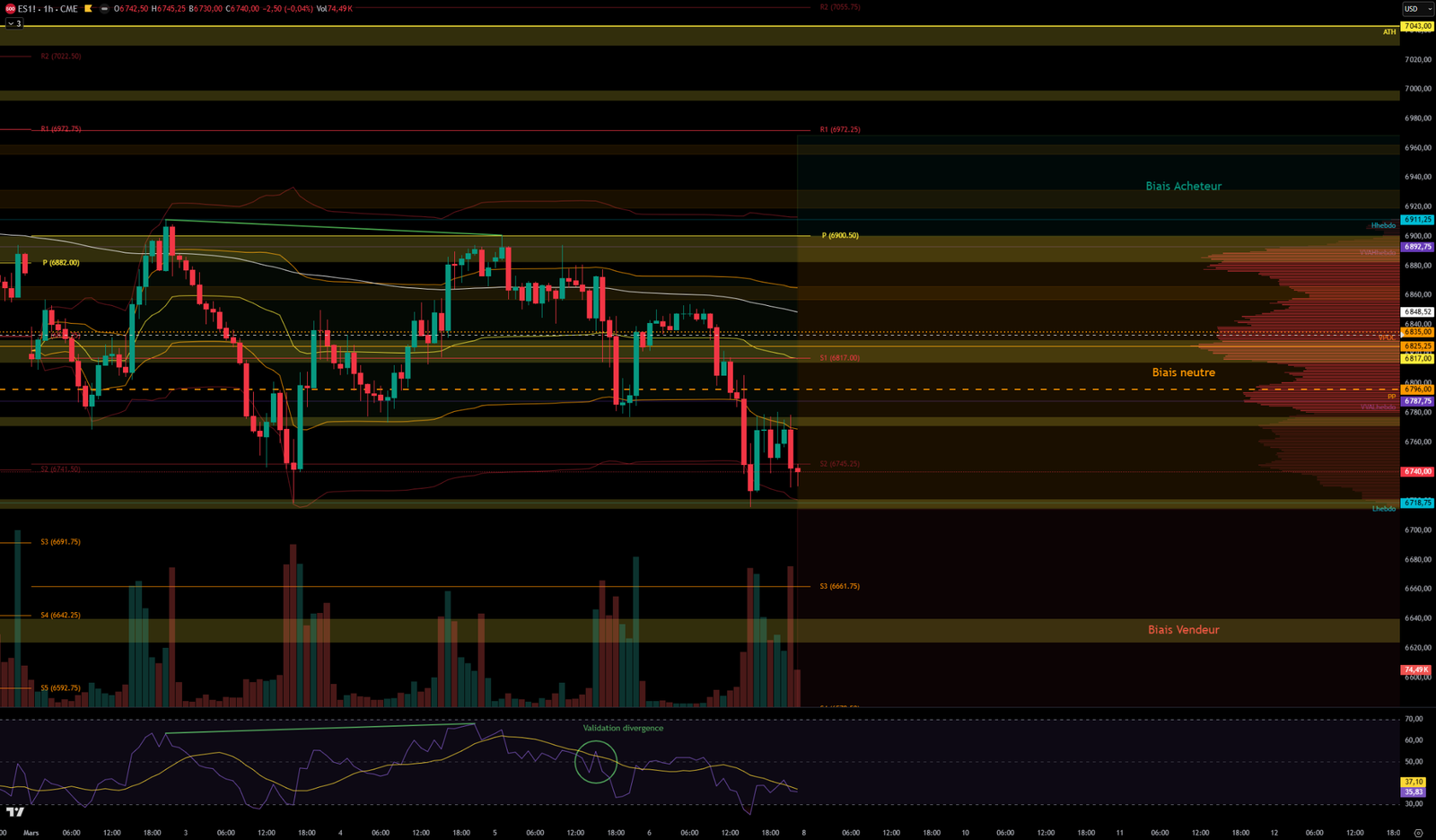
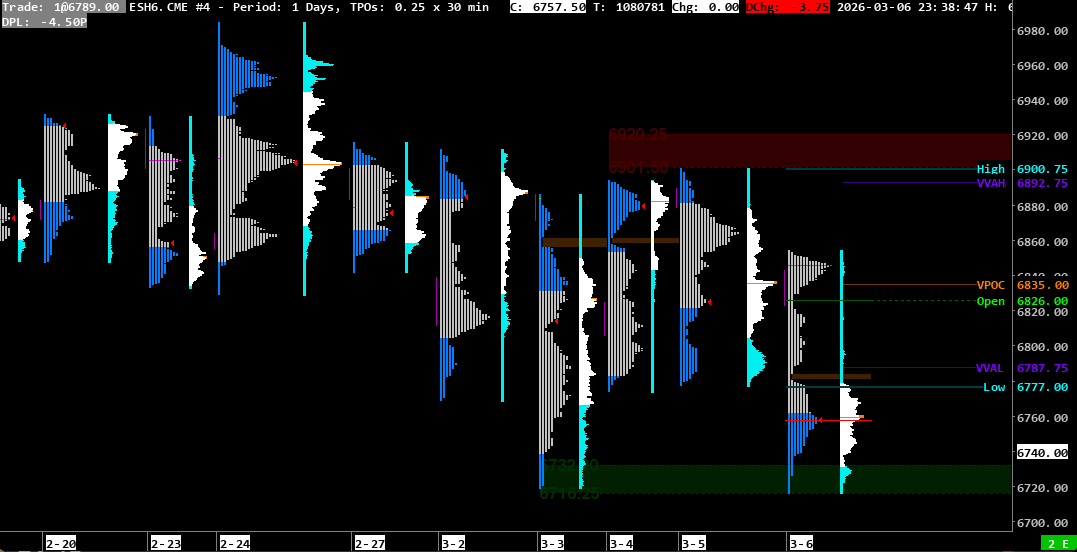
VPOC: 6835
LOW-HIGH: 6718.75 – 6911.25
VVA: 6787.75 – 6892.75
Pivot Point: 6796
This week, the S&P 500 lost 1.12% after a turbulent week with very high volatility.
The price began the week with a bearish gap opening at 6820 amid the conflict between the US and Iran. However, the gap was filled the same day. After an attempt early in the week and another on Thursday, the US index was never able to break the 6900 level.
On Tuesday, the price suffered a heavy decline, stopping at the 6715-6720 support zone. Buyers responded and pushed the price back toward the 6883-6900 resistance zone. Once again, sellers pushed the price back down to the same 6715-6720 support level.
During Friday’s drop, the price created a single print at the 6780-6785 level, which also corresponds to Thursday’s low. This single print is located just below the weekly pivot point at 6796. This level will play a vital role and will be an important threshold to cross for any potential upside.
Given the geopolitical situation, macroeconomic data, and the retreat of tech companies, selling pressure is clearly present. Indicators across all timeframes are bearish, and a hidden bearish divergence can even be observed, which could indicate a continuation of the downward movement, especially if the 6715-6720 support zone, which held the price all week, gives way.
This 6715-6720 support and the 6883-6900 resistance zone will once again be key areas if the support holds.
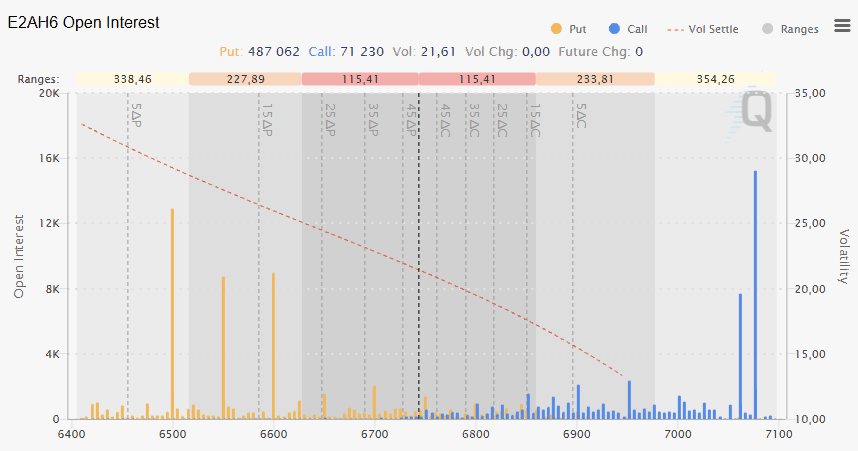
Regarding options, a large majority of puts can be seen with significant interest at the 6600, 6550, and 6500 levels, while we have two large distant call levels at 7060 and 7075.
Points of Interest
- 7030-7043 (Major Resistance Zone)
- 6920-6930 (Resistance Zone)
- 6883-6900: (Major resistance zone)
- 6815-6830 (Resistance zone)
- 6796 (Weekly pivot point)
- 6771-6777 (Resistance zone)
- 6715-6720 (Support zone)
- 6625-6640 (Support zone)
- 6550-6560 (Support zone)
- 6444-6460 (Support zone)
Overall Sentiment: Bearish








0 Comments