
Will Nvidia move or not?
Economic Announcements:
- 4:30 PM: Crude oil inventories
Earnings Reports:
- NVIDIA (NVDA)
- The TJX Companies (TJX)
- Salesforce Inc. (CRM)
- Lowe’s Companies (LOW)
- Synopsys (SNPS)
- Ferrovial (FER)
- Agilent Technologies (A)
- VICI Properties (VICI)
- Universal Health Services (UHS)
- Pinnacle West Capital (PNW)
- APA Corporation (APA)
Analysis:
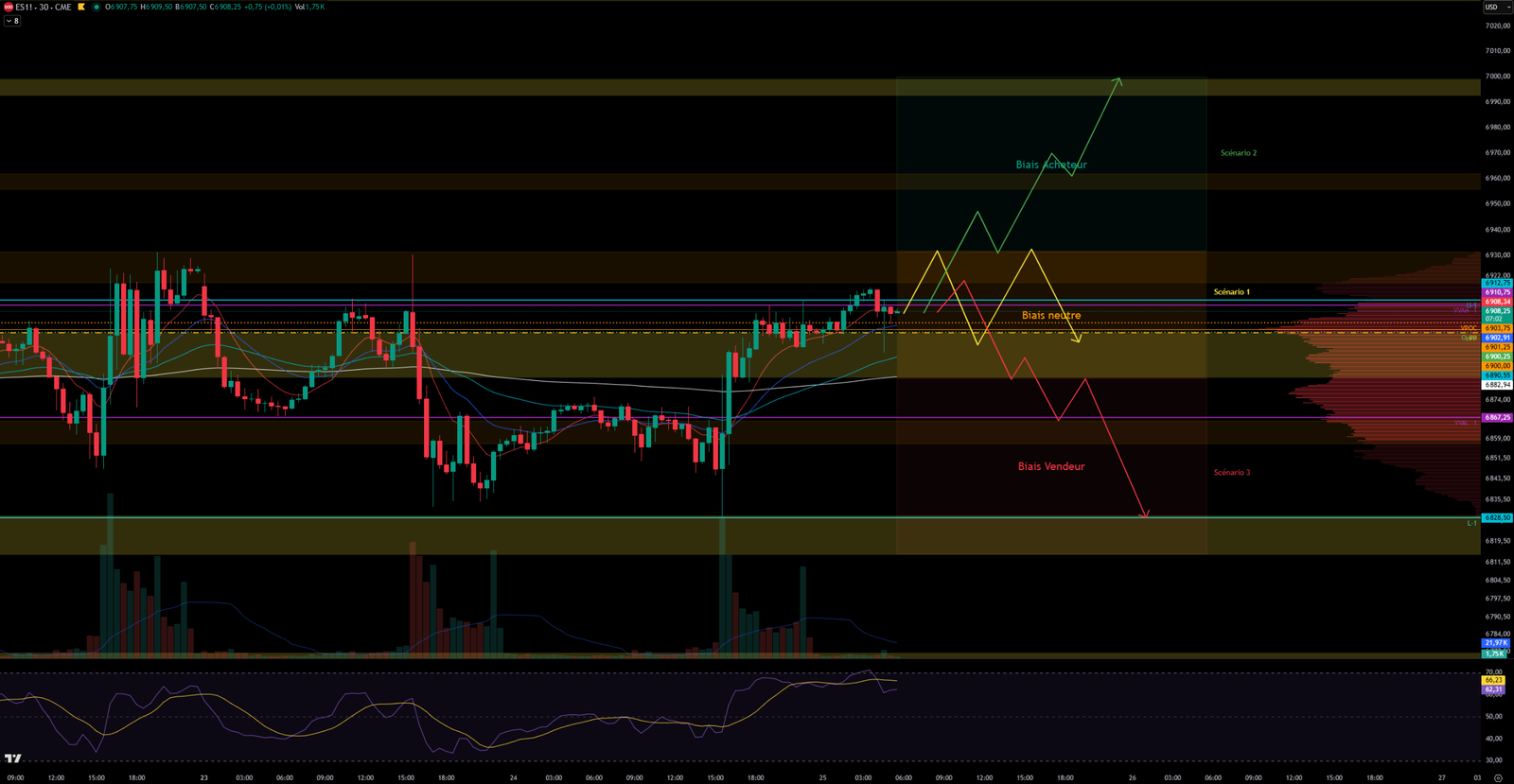
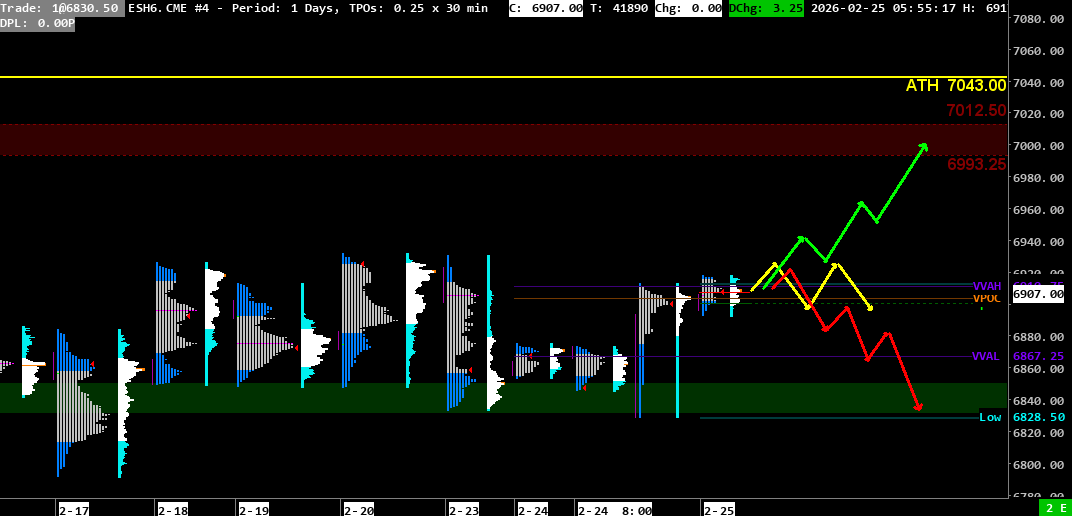
VPOC: 6903.75
VVA: 6867.25-6910.75
High-Low: 6828.50-6912.75
PP: 6900
Open: 6900.25 (Zone 1)
VIX: 19.56
S&P 500 trend: Neutral 🟠 to bullish 🟢
Yesterday, the S 500 opened in the 6857–6866 resistance zone and saw a morning of consolidation around that area, with some back-and-forth between sellers and buyers. Price finished slightly lower before the US open. The VPOC zone at 6850 supported price for much of the morning, and price remained within the prior day’s value area.
At the US open, sellers pushed price down to the 6830 support level after testing the VVAL-1 and the prior day’s low. From there, buyers took control, driving price into the major 6883–6900 resistance zone which, after an initial attempt rejected by sellers, eventually broke. Price held above that zone into the close. The index was boosted by the tech and AI sector, notably thanks to AMD, which rose following a deal with Meta to supply AI chips.
This morning, the S 500 is opening in Zone 1 at 6900.25. Sellers attempted to move back below 6900, but there was a strong rejection from buyers, with heavy volume and a long wick on the 4:30 candle, possibly showing investors’ willingness to stay above 6900.
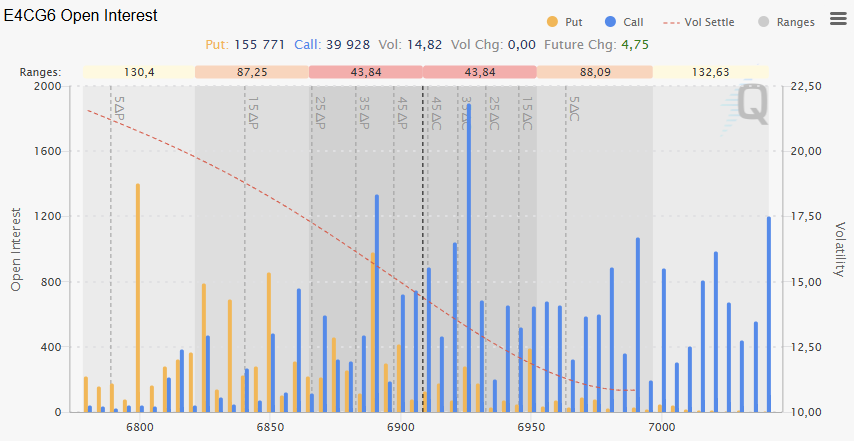
On the options board, one can note a large Calls zone at 6925 as well as at 6890, and a large Puts zone at 6800. The 6920–6930 resistance level should be difficult to break.
Today, Nvidia will report earnings after the close and, in the event of a negative surprise, things could move quickly. Nvidia is facing increasing competition, as we saw earlier with AMD, but also from Google and other companies trying to reduce their dependence. Price may trade sideways while awaiting these results.
On the macro side, we will only have crude oil inventories today.
Scenario 1 🟡: On a rejection from the 6920-6930 resistance zone, price could move sideways between that area and the 6883-6900 support zone.
Scenario 2 🟢: On a breakout of the 6920-6930 resistance zone, price could move higher and target the 6956-6962 area, then aim for 7000.
Scenario 3 🔴: On a break below 6900 and the 6883-6900 support zone, price could target the 6857-6866 area and then the 6815-6830 area.
Things could move overnight after Nvidia’s earnings.
Zones of Interest:
- 7030-7043 (Major resistance zone + ATH 7043)
- 6993-7000 (Resistance Zone)
- 6956-6963 (Resistance zone)
- 6920-6930 (Resistance zone + large Calls zone 6925)
- 6903 (Yesterday’s VPOC)
- 6883-6900 (Major resistance zone)
- 6857-6866 (Support Zone)
- 6815-6830 (Major Support Zone)
60-second Chrono

Market Performance
Wall Street ended the day with gains, particularly in the technology sector, due to renewed interest in artificial intelligence (AI). The S 500, Dow Jones, and Nasdaq indices all posted significant increases.
Interest rates and the dollar
Treasury yields rose ahead of President Trump’s address to Congress. The dollar strengthened, which had a negative effect on gold prices.
Trump’s speech
In his State of the Union address, President Donald Trump stated that the United States was “richer and stronger than ever” while defending his economic policies amid a climate of concern among voters ahead of the midterm elections.
Upcoming Company Earnings
Several companies, including Nvidia, Paramount Skydance and Lowe’s, are due to report earnings. Investors are expecting solid performance, especially from Nvidia, due to growing demand for AI-focused data centers.
Latin American economy
Mexico recorded a current account surplus in the fourth quarter, and important economic data are expected from Brazil and Argentina.
Technology industry news
AMD has reached a major deal with Meta to supply AI chips, underscoring the growing competition in the sector. Nvidia is facing competitive pressure with strong earnings forecasts, but potentially slowing growth.
Geopolitical Context
Nuclear talks between the United States and Iran are ongoing, influencing oil prices, which are stabilizing despite tensions.
Consumer Confidence
Consumer confidence in the United States increased, although concerns remain about the labor market and unemployment.
Economic Forecasts
Despite uncertainties, analysts are forecasting a 10% rise in the SP 500 index by year-end, supported by strong earnings and economic growth.
Macro

Labor Market: Weak hiring momentum
- Weekly ADP employment change:
Current: 12.80K
Previous: 11.50K
-> Although the current figure is very slightly higher than the previous one, the creation of only 12,800 jobs is an extremely low level. This is a clear signal that the labor market is cooling. Companies are sharply slowing hiring, likely in response to economic uncertainty and high financing costs. Less hiring means less upward pressure on wages.
Real Estate Sector: A market under pressure from interest rates
SP/CS Composite-20 Home Price Index (Monthly) (Dec):
Current: -0.1%
Previous: 0.0%
SP/CS Composite-20 Home Price Index (Year-over-year) (Dec):
Current: 1.4%
Forecast: 1.3%
Previous: 1.4%
-> Real estate is sending us a two-part message. First, the negative monthly figure is the most responsive data point: it proves that high mortgage rates are choking off immediate demand, forcing prices lower in the short term. Second, the annual figure (1.4%) slightly beats forecasts but is flat versus the prior month. This indicates that despite the drop in demand, the shortage of homes available on the market is preventing a total collapse in prices over the long term. The market is bending, but not breaking.
Summary
- The cooling is becoming broad-based: A labor market struggling to create jobs and a real estate sector that is starting to see monthly price declines is music to the Fed’s ears. It proves that its restrictive monetary policy is successfully transmitting to the real economy. By reducing households’ purchasing power and tightening credit, the Fed is ensuring that inflation will not reaccelerate.
Consumption: An unexpected rebound in optimism
- Consumer Confidence – Conference Board (Feb.):
Current: 91.2 - Forecast: 87.4
Previous: 89.0
-> This is a very clear signal of strength that catches the market off guard. Not only is the figure up from the prior month, it absolutely crushes the consensus. . This jump indicates that the American consumer—the true engine of the US economy—remains highly confident and feels financially secure.
Summary
- A headache for the Fed: While housing data and industrial orders showed clear cooling, the American consumer is holding firm. If households are confident, they keep spending. That is excellent for pushing back the risk of recession, but it is a danger for Federal Reserve policy: strong consumption tends to keep inflation elevated. The Fed may see this as a reason not to cut interest rates too quickly.





0 Comments