
Gold, the law, and blood
Economic Announcements:
- 2:00 PM : Fed’s Waller Speech
- 4:00 PM: Factory Orders (December)
Earnings Reports:
- ONEOK (OKE)
- Diamondback Energy (FANG)
- Keysight Technologies (KEYS)
- Erie Indemnity (ERIE)
- Domino’s Pizza (DPZ)
Analysis:
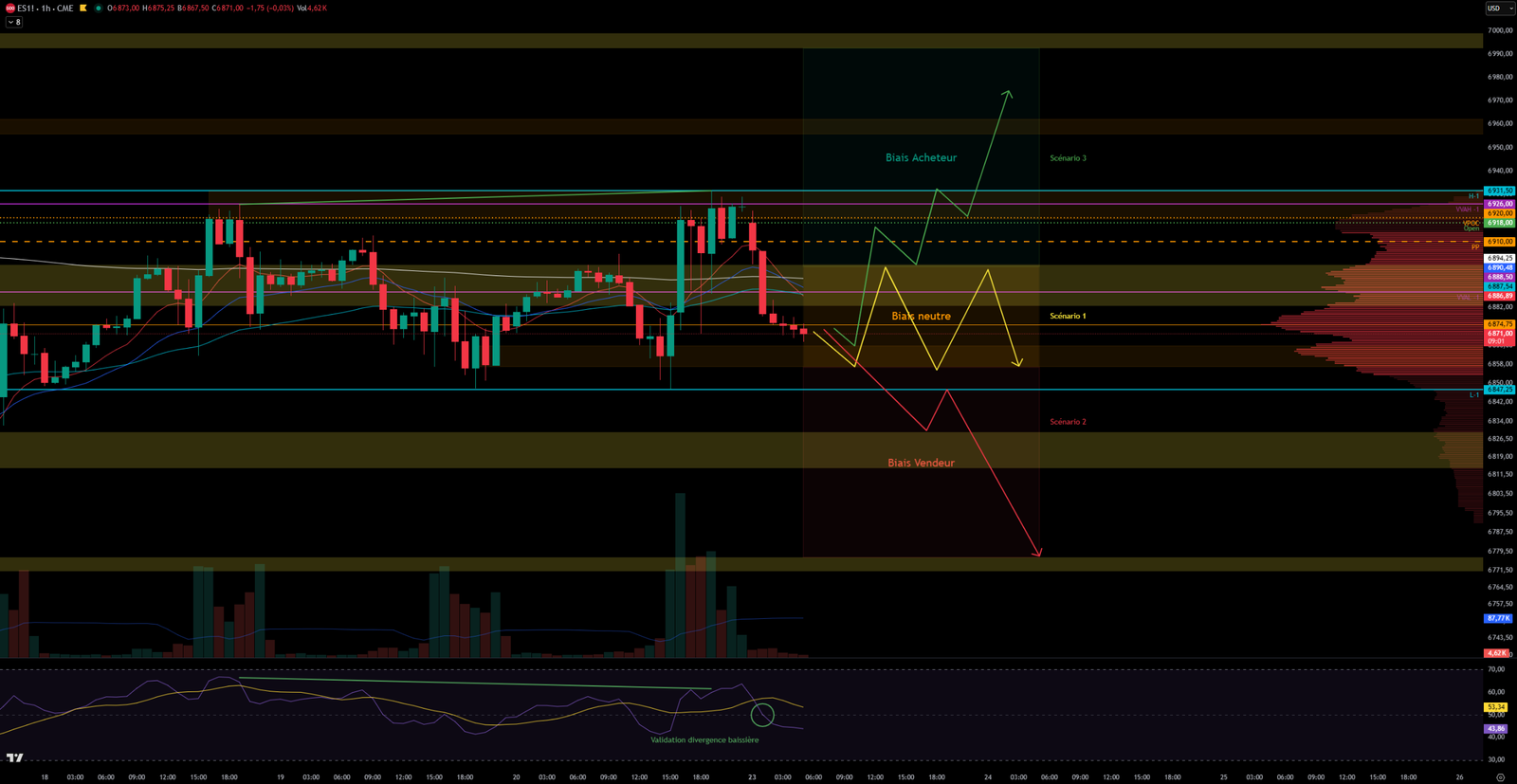
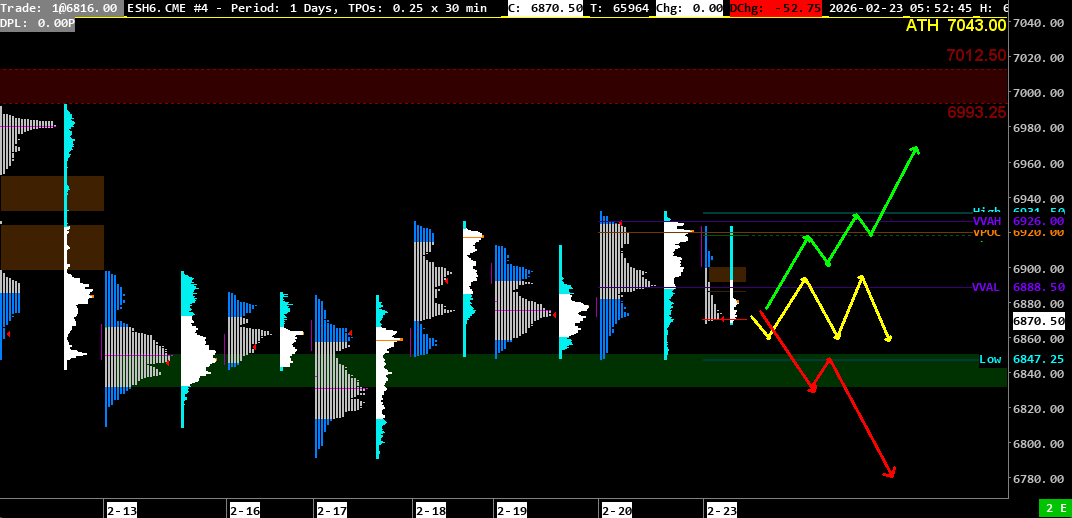
VPOC: 6920
VVA: 6888.50 – 6926
High-Low: 6847.25 – 6931.50
PP: 6910
Open: 6918
Vix: 19.08
SP 500 Trend: Overall sentiment neutral 🟠 to bearish 🔴
On Friday, the S 500 spent the morning consolidating in the 6883-6900 resistance zone until 12:00 PM after attempting a breakout of 6900. The price then declined and reached the previous day’s lows at 6848 following the GDP and PCE data and before the US open. Macro figures showed a slowdown in the US economy.
At the US open, buyers took control, pushing the price back up just below the 6883-6900 resistance zone. However, around 4:00 PM, the US Supreme Court announced the cancellation of Trump’s tariffs, which propelled the index upward, causing it to break 6900. But the price stalled at the 6920-6930 resistance zone, which it failed to cross. After a rejection attempt by sellers, the price stabilized between the 6883-6900 support zone and the new 6920-6930 resistance zone, where the S 500 closed.
This morning, the S 500 opened in Zone 1 at 6918, near the declining VVAH-1. Sellers pushed the price down, which fell back below the 6883-6900 support zone and returned to last week’s range between this 6883-6900 zone and the 6857-6866 support zone. This area also corresponds to the weekly VPOC and the weekly VWAP. However, the price also fell below Friday’s value area by breaking the VVAL-1 at 6888.50. The price is currently consolidating in this zone. On the 30-minute chart, we can observe a confirmed bearish divergence. Additionally, a single print formed during this morning’s drop between 6892-6900, further strengthening the 6883-6900 resistance zone. The price appears bearish this morning, but we must wait for the European and US opens to confirm the trend, as the Asian session is reacting to Friday’s news.
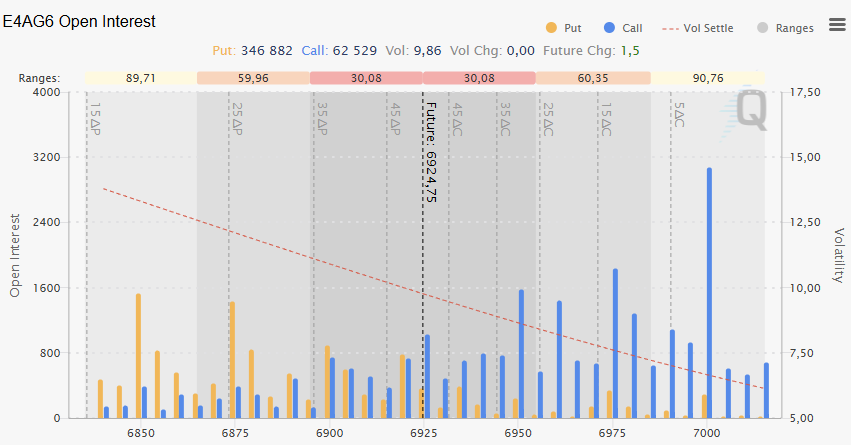
Regarding options, we can see the Call zone still at 7000 and Put zones at 6850 and 6875.
Today, we will have a speech from the Fed’s Waller at 2:00 PM as well as factory orders at 4:00 PM. It will also be necessary to monitor the news and Trump’s statements following the cancellation of the tariffs.
Scenario 1 🟡: Upon rejection below the 6857-6866 resistance zone, the price could consolidate in the 6857-6900 zone.
Scenario 2 🔴: Upon a breakout of the 6857-6866 zone, the price could test Friday’s low at 6847 and target the 6815-6830 support zone, and if broken, the 6770-6777 zone.
Scenario 3 🟢: To confirm this scenario, the price must break the 6920-6930 level, which includes Friday’s high, the VVAH-1, the open, and the VPOC-1. Before that, the single print at 6892-6900 must be filled and the 6883-6900 resistance zone broken; the price could then target Friday’s highs at 6931 and move toward the 6956-6963 resistance zone.
Zones of Interest:
- 7030-7043 (Major resistance zone + ATH 7043)
- 6993-7000 (Resistance Zone)
- 6956-6963 (Resistance zone)
- 6920-6930 (Resistance Zone + Friday High 6931 + VVAH-1 + Open + VPOC-1)
- 6883-6900 (Major resistance zone)
- 6857-6866 (Support Zone)
- 6815-6830 (Major Support Zone)
- 6,770-6,777 (Support Zone)
60-second Chrono

Increase in Yields
Yields on Wall Street and Treasury bonds rose after the Supreme Court struck down Trump’s global tariffs, providing some relief to investors.
Upcoming Economic Data
The Census Bureau is scheduled to release factory orders data, with a forecast of a 0.5% decline for December, following a gain in November. Other major announcements include financial results from several companies, notably Nvidia and Hims Hers.
Wall Street remains calm after the cancellation of tariffs
- Legal Decision: On Friday, the US Supreme Court (case Learning Resources, Inc. v. Trump) ruled that the President did not possess the unilateral authority to impose these import taxes.
- Historical Context: Trump had invoked the International Emergency Economic Powers Act, an unprecedented move in the 50-year history of this law.
- Financial Stakes: Potential refunds could amount to $175 billion, impacting public finances and over 300,000 importers.
- Executive Reaction: Trump announced his intention to replace these taxes with a 10% global tariff via other trade legislative levers.
- Global Consequences: This decision marks a check on executive power in the face of a trade deficit that reached $1.2 trillion in 2025.
Impact on the dollar and the oil market
The dollar fell following the decision, while oil prices showed signs of volatility due to geopolitical tensions, particularly between the United States and Iran.
Consequences for businesses
The Supreme Court’s decision could have long-term repercussions on trade practices and international relations, with companies preparing to navigate an uncertain trade environment.
Economic Outlook
Analysts point out that while the decision is a victory for some companies, it may not provide immediate relief to the global economy due to persistent uncertainty regarding new tariffs and refunds of the canceled taxes.
China monitors Trump’s new trade moves after US court defeat
China stated it is closely monitoring the Trump administration’s plan to move forward with its tariff regime using other trade tools, in its first official remarks since the Supreme Court invalidated the President’s emergency tariffs.
Mexican army kills cartel leader “El Mencho” in US-backed raid
- One of the most significant captures of drug kingpins triggers a wave of violence
- Nemesio Oseguera “El Mencho” led the Jalisco New Generation Cartel
- The Trump administration calls the operation a “major breakthrough”
Macro

US Economy: Growth slows down, inflation remains resilient
Growth (GDP): A surprise sharp slowdown
- GDP (Quarterly) (Q4):
Actual: 1.4%
Forecast: 2.8%
Previous: 4.4%
-> This is the shock of this publication. While previous data showed resilience, this preliminary official figure marks a very severe halt. Growth is half as strong as expected. This is mathematical proof that the Fed’s high interest rates are finally starting to strangle the real economy.
Inflation (PCE): The bad surprise for the Fed
Core PCE (Monthly) (Dec):
Actual: 0.4%
Forecast: 0.3%
Previous: 0.2%
Core PCE (Annual) (Dec):
Actual: 3.0%
Forecast: 2.9%
Previous: 2.8%
-> The Core PCE index is the Federal Reserve’s preferred inflation gauge. The fact that it came in higher is an alarm signal. Despite the GDP slowdown, prices continue to rise faster than expected. This is the worst-case scenario for a central bank: inflation is “sticky” and refuses to die.
Business Activity (PMI): Momentum is fading
Manufacturing PMI (Feb):
Actual: 51.2
Forecast: 52.4
Previous: 52.4
Services PMI (Feb):
Actual:52.3
Forecast: 53.0
Previous: 52.7
-> This confirms the GDP figure. Purchasing managers are seeing a slowdown compared to the previous month. Note, however, that the figures remain above 50, which means the economy is still technically expanding, but the engine is running significantly slower.
Consumption and Real Estate: The consumer bends but does not break
Household Spending (Monthly) (Dec):
Actual: 52.3
Forecast: 53.0
Previous: 52.7
New Home Sales (Dec):
Actual: 745K
Forecast: 732K
Previous: 656K
Michigan Index – Inflation Expectations:
Actual: 3.4%
Forecast: 3.5%
Previous: 4.0%
-> Despite the overall slowdown, the American consumer continues to spend exactly as expected. New real estate even surprises to the upside, showing that there are still buyers despite the rates. Another positive point for the markets: consumers see future inflation decreasing, which limits the risk of a wage-price spiral.
Summary
- The specter of stagflation: GDP collapses to 1.4% but PCE inflation is re-accelerating. This is a complex configuration for risky assets, as corporate margins are likely to be under pressure.
- The Fed trapped: With growth falling to 1.4%, the Fed would normally lower its rates to jumpstart the economy. But it cannot because Core PCE is re-accelerating to 3.0%. The Fed’s hands are tied. It will have to maintain high rates to kill inflation, at the risk of permanently breaking growth.




0 Comments